
As a DBA#
As a DBA, I strongly believe in first principles and information theory when it comes to problem analysis. A DBA needs to deeply understand the system, understand PostgreSQL, to explain anomalies from first principles. For example, in the first half of the year I spent considerable effort understanding Linux memory, exploring the essence of memory issues and their solutions. At the same time, this year I took a step forward in system operations — no longer focusing solely on technical problems and handling, but more on providing solutions. These should encompass thinking across the PostgreSQL database technology dimension, the system dimension, and the management dimension.
Here’s a simple classification of cloud DBA work:
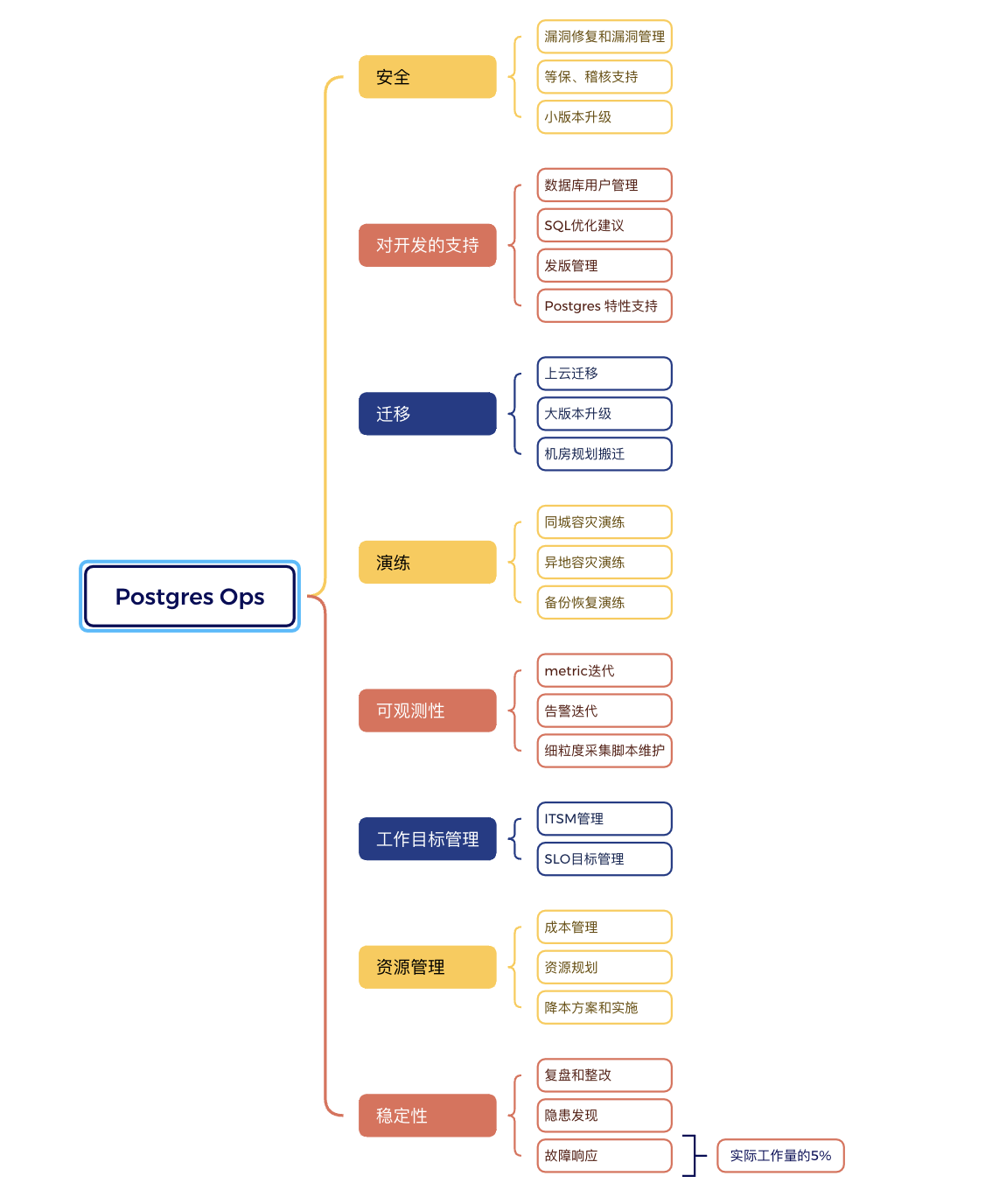
Many Ops papers only talk about incident handling, but in reality, incident handling probably accounts for less than 5% of actual operational workload. And whether in academia or practice, anomaly ops itself isn’t very effective anyway. So I’m not very bullish on AIOps being able to significantly help DBAs. Note that DBAs using AIOps and DBAs using AI are two different things.
Actually, this diagram is just so-so, because it doesn’t include leadership tasks, which are definitely the bulk.
Looking back at the 2023 and 2024 year-end summaries, I can simply summarize my DBA work year by year:
- 2023: Comprehensive PostgreSQL learning
- 2024: Comprehensive PostgreSQL operations
- 2025: Responsible for emotional support
What’s deeply ironic is that last year’s conclusion — “DBAs are providing emotional support to their leaders” — became my lived reality this year. I don’t want to say more about it. In short, it’s been exhausting, mentally draining. I hope next year brings improvement.
READING#
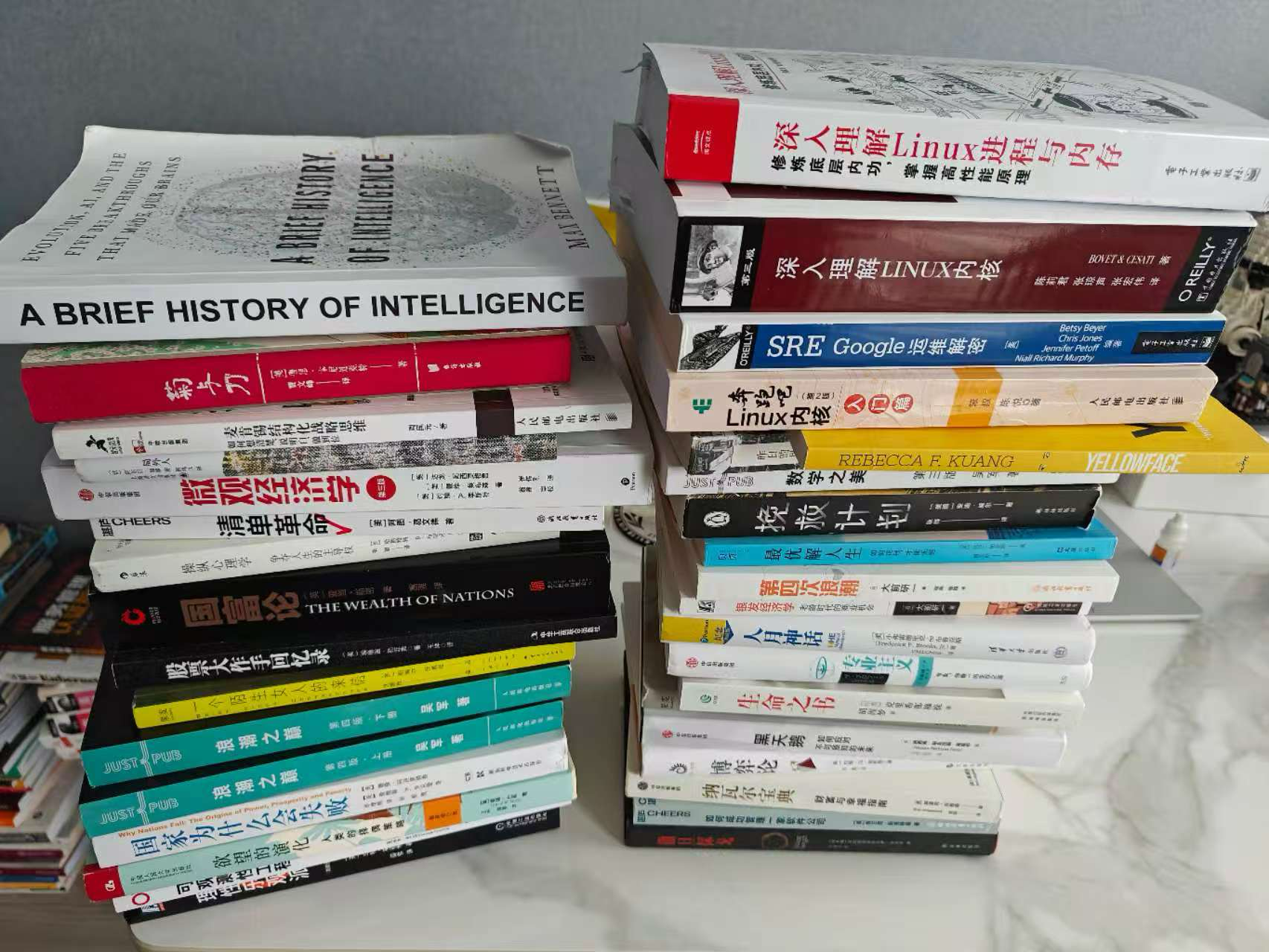
This year I read even more books than last year (from 20+ to 30+), but wrote even fewer reading notes. Writing is indeed troublesome and energy-consuming, and I’ve grown to prefer the feeling of reading itself. Compared to last year, this year’s reading shows a clear decrease in PostgreSQL technical books, an increase in comprehensive technical books, and I even started reading psychology, economics, and philosophy. In short, broader hunting grounds, not limited to databases alone. Also fewer novels — novels are like snacks, and I’m increasingly losing interest in such non-nutritious content.
This year’s book list generally falls into: IT Systems, Economics, Popular Science, Spiritual, and Fiction categories. As with last year, ranked by personal preference.
IT Systems Book List:
“SRE: Google’s Approach to Service Reliability” — DBAs are not SREs, but their work involves system stability objectives, which has similarities with DBA work. Some content in this book about cloud environments or management aspects was truly enlightening — for example, SLA, systems engineering, operational pressure, busy work, role rotation, “trust the team rather than a single technical expert,” and more. Absolutely brilliant. Recently I also heard the term DBRE — Database Reliability Engineer — which fits my current role even better than DBA. In short, an excellent book, a must-read for modern ops.
“Running Linux Kernel: Introduction” — operating open-source databases requires understanding the operating system. One of my books for studying Linux memory.
“Deep Understanding of Linux Processes and Memory” — one of my books for studying Linux memory.
“Understanding the Linux Kernel” — one of my books for studying Linux memory.
“Observability Engineering” — the patterns and flaws of traditional monitoring and traditional ops, and what observability essentially means. Quite helpful.
Economics Book List:
“Microeconomics” — a masterpiece, by Daron Acemoglu. I consider it essential reading for life. This book has my best notes of any book. Not only understanding economics, but further understanding society. Some viewpoints left a deep impression on me:
- Proves why the market is an invisible hand that maximizes social surplus value — any intervention reduces social surplus value.
- Under what circumstances markets are ineffective: externalities, public resources, and common-pool resources.
- Women earn less than men in the workplace partly because women bear children and cannot participate in production during that time.
- The function of academic credentials is signaling — to a certain degree, they certify the productive value of the person.
- Business entry and exit are normal market signals, not signs of disorder.
- The trade-off between equity and efficiency is a subject of study.
“Why Nations Fail” — a masterpiece, by Daron Acemoglu. This book can be summarized in one sentence: Why do nations succeed? Because of creative destruction. Daron Acemoglu won the 2024 Nobel Prize in Economics for “research on how institutions are formed and how they affect prosperity.” What’s even more remarkable is that this book is easier to understand than other economics works. The top-recommended economics masterpiece.
“The Rational Optimist” — said to rival “Sapiens,” but it’s definitely a notch below. However, the content quality isn’t bad, and it’s more economics-oriented. Some viewpoints are very fresh, for example:
- Modern economics makes the rich richer, but the poor are not getting poorer.
- Self-sufficiency is poverty.
- What distinguishes humans from animals is barter exchange (in “Sapiens” it’s the cognitive revolution).
- Higher income leads to greater happiness — this is a fact.
- The elevation of trade in social status came from the rise of maritime trade, because land trade was unstable and easily plundered.
“Reminiscences of a Stock Operator” — feels like I learned something and nothing at the same time. Decent read though.
“Game Theory” — honestly, I found it average. Not much content, quite superficial. I mainly read it because economics books keep mentioning game theory, so I flipped through it to evaluate.
“The Wealth of Nations” — extremely dense, not for normal people to read. Incredibly content-rich. Adam Smith must have been a genius — hard to imagine what kind of mind produced this. Too difficult for me, didn’t finish, gave up.
Popular Science Book List:
“A Brief History of Intelligence” — a masterpiece, essential reading for the AI era. This book is worn from my constant reading, covered in notes everywhere. Deconstructing the human brain, understanding what intelligence is, understanding how AI came to be. I give it full marks! Now whenever I see any animal, I first think about what intelligence level it’s at…
“On Top of Tides” — by Wu Jun. Every IT professional should read this book. It tells the rise and fall of major IT companies. You can learn about Oracle, Google, Fairchild, Bell Labs, and even basics about venture capital. Every company has its own DNA, which is nearly unchangeable and determines the company’s culture and characteristics. A programmer’s must-read.
“The Almanack of Naval Ravikant” — has many useful perspectives, like views on marginal utility. And more importantly, it recommended one of my favorite books this year — “Microeconomics.” It also recommended meditation, which changed my habits.
“How to Manage a Software Company” — by Frank Slootman, a legendary Silicon Valley CEO who led three software companies (ServiceNow, Data Domain, Snowflake) to successful IPOs. A very good book, looking at company development, employee management, execution, decision-making, and decision failures from an IT company manager’s perspective. Highly recommended.
“The Economics of Aging” — by Kenichi Ohmae. Using Japan’s aging problem to glimpse China’s aging problems and opportunities. The demographic structural risks in our country are severe and about to come to a head. In this era, highly recommended reading.
“The Fourth Wave” — by Kenichi Ohmae. Mainly about how Japan missed the IT technology wave, still relying on old industries to support the national economy, appearing somewhat envious of South Korea and China. I personally love the author’s attitude of directly criticizing the prime minister, haha.
“The Checklist Manifesto” — explains the necessity of checklist inspections before Western surgical procedures. Seemingly simple steps can dramatically increase surgical success rates. This book had a big impact on my work — I genuinely brought the checklist concept into my work. I treat database operations like a surgical procedure — checklists are a simple yet necessary means to improve success rates.
“The Mythical Man-Month” — “adding people” cannot linearly reduce systems engineering project timelines, but you also can’t simply reject “adding people” because large systems engineering projects genuinely require many people collaborating. It’s a good book, but calling it a programmer’s must-read feels like a stretch.
“The Beauty of Mathematics” — by Wu Jun. Also quite good. Technology always has its mathematical foundations. This book accessibly tells the beauty of mathematics.
“McKinsey Structured Thinking” — any problem should be structurally decomposed. When I encounter new problems, I think this way. A useful book.
“The Chrysanthemum and the Sword” — stock from years ago that I dug out to read. An American’s post-WWII perspective on Japan. You can glimpse aspects of Japanese culture like modified Confucianism without “benevolence (ren),” the psychology of indebtedness, etc. One drawback is it’s quite dated — modern Japan is largely different from that era.
“The Black Swan” — a black swan refers to unforeseen extreme events. Black swan events will always happen — there’s no such thing as 100% accurate prediction. It also discusses classification, which reminded me of content from “Structured Thinking” and “The Worlds I See”: “The essence of human understanding is classifying things,” but classification always awkwardly leaves some things unclassifiable or unable to be classified. Black swan events exist from the moment of classification. An interesting and noteworthy reflection.
“The Professional” — by Kenichi Ohmae. Very mediocre, not recommended.
Spiritual / Self-Help Book List:
- “The Evolution of Desire” — evolutionary psychology, a masterpiece.
- “Die with Zero” — experience the right things at different life stages. Even if you revisit something after missing it, it won’t feel the same as experiencing it at the right time. A life manual, highly recommended.
- “Ten Minutes Meditation” — mainly about the importance of meditation and how to do it. I learned meditation through this book. When I first completed meditation, I fell in love with it. It gave me a feeling of being taken to outer space and then returning to Earth. More importantly, it truly relieves stress. Meditation has become part of my life.
- “The Manipulation Bible” — okay.
- “Siddhartha” — incomprehensible, rubbish.
- “The Book of Life” — pure chicken soup, rubbish.
Fiction Book List:
- “The Stranger” — a masterpiece. An indescribable sense of authenticity, feeling like an outsider oneself.
- “Yellowface” — a very interesting book about a white American woman who plagiarizes an unpublished work by a deceased Asian writer, even using a very Chinese pen name. When fans discover she’s white, you can feel the embarrassment. Playfully explores racial prejudice. As thrilling as watching a TV drama — twists and turns, gripping. Highly recommended.
- “The World of Yesterday” — by Stefan Zweig. Austria, Europe, WWI and WWII through a writer’s eyes. Returning to that turbulent Europe from a different angle. A very good book.
- “Project Hail Mary” — sci-fi. I increasingly dislike reading sci-fi. This one is okay: imagine you’re on an alien exploration mission, all your crewmates have died, and you happen to encounter a friendly alien. How do you communicate with them…
- “Letter from an Unknown Woman” — by Stefan Zweig. Not good. Only the first story is somewhat novel. No interest in seriously reading the other two.
- “Satantango” — incomprehensible. Even Nobel Prize in Literature winners vary in quality.
Blog and WeChat Official Account#
The name of my WeChat Official Account has always been a struggle. I didn’t put much thought into maintaining it anyway, so I casually used a few names. This year I watched a documentary — “The Last Porter”, which moved me deeply. The DBA profession, like the porters of Chongqing, is undergoing tremendous change. So I simply changed it to “The Last DBA”. This name rolls off the tongue nicely and carries some historical context and philosophical reflection. Seems like a good name.
Since a lot of time goes into work, I didn’t have much time for writing to begin with. Plus, this year my operational approach kept changing, and no matter how I adjusted my daily schedule, I couldn’t carve out a good time slot. I even invested some money, and my time still didn’t increase, which frustrated me for quite a while. Looking back now, I only published 12 articles this year — not even one in the first half of the year.
Very dissatisfied. 😠
I don’t know if my skills have improved or if the system is genuinely stable, but cases worth deep research seem to have become fewer. But this isn’t really a big problem. This year I also started treating paper interpretation as an article type. I personally feel the results are decent — I can learn quite a bit, without being too insular or reinventing the wheel. Using AI to interpret papers would certainly be fast, but I personally feel there are two problems:
- Do I truly understand? I feel like I don’t — it’s not the same concept as reading through it myself. Reading it yourself not only allows deeper understanding but also lets you discover all sorts of quirky details.
- Can’t just inflate article length. If I can interpret a paper with one prompt, then I feel the dissemination value is minimal — surely there’s no one not using AI now, right?
Of course, I don’t read every paper word by word — that would be too inefficient. I only select papers that I feel are good and worth frame-by-frame interpretation, and savor them carefully.
A quick summary of this year’s articles:
- Too few in quantity
- Slightly improved quality, and useful content (several articles I’m personally very satisfied with)
- Explored new formats
Final Thoughts#
This year was a busy one, with both bad and good memories. Many important things were left unfinished. Next year should bring significant changes. Writing this year-end summary is quite interesting — looking back to see what my past selves were up to is a fun experience.
Last year’s 2025 OKRs:
- Continue some things — FAILED
- Think about how to produce output — FAILED
- Master another track — HALF SUCCESSFUL
- PostgreSQL… haven’t figured out what more to do — FAILED
- Find a way to resume fitness — FAILED
2026 Plan:
- Continue some things
- Pay attention to my psychological and physical health — next year’s annual health inspection alerts should be lower than this year’s
- Pay attention to article readership, maintain the WeChat Official Account
- Explore DB AI Ops, report to myself next year
- Manage upward — don’t invest too much time in work
- Travel during holidays instead of overworking
- Read no fewer than 30 books, but don’t focus solely on quantity