
As a DBA#
2023 was a year of comprehensive PostgreSQL learning for me, and 2024 has been a year of comprehensive PostgreSQL operations. There’s actually a lot of material I really want to dive into but haven’t had the time. This year was mainly case analysis — I could only supplement my foundational knowledge here and there.
Mid-year there was a discussion about “will DBAs be eliminated in the cloud era.” This discussion left a deep impression on me. I thought about many things afterward — why do others seem to have so few things to deal with while I, as a DBA, have so much? I even went into cloud computing groups to debate about it, and I actually gained something from it. Different perspectives lead to unexpected conclusions. The conclusion of the debate may boil down to just one thing: DBAs are providing emotional support to their leaders.
Right or wrong, you can see reflections on the DBA profession in many of my articles this year. Continuing down the traditional DBA path is certainly a dead end. Today’s DBAs lean more toward business data layer operations, or moving up to architecture design. Positions for expert DBAs focused purely on databases are actually very few.
READING#
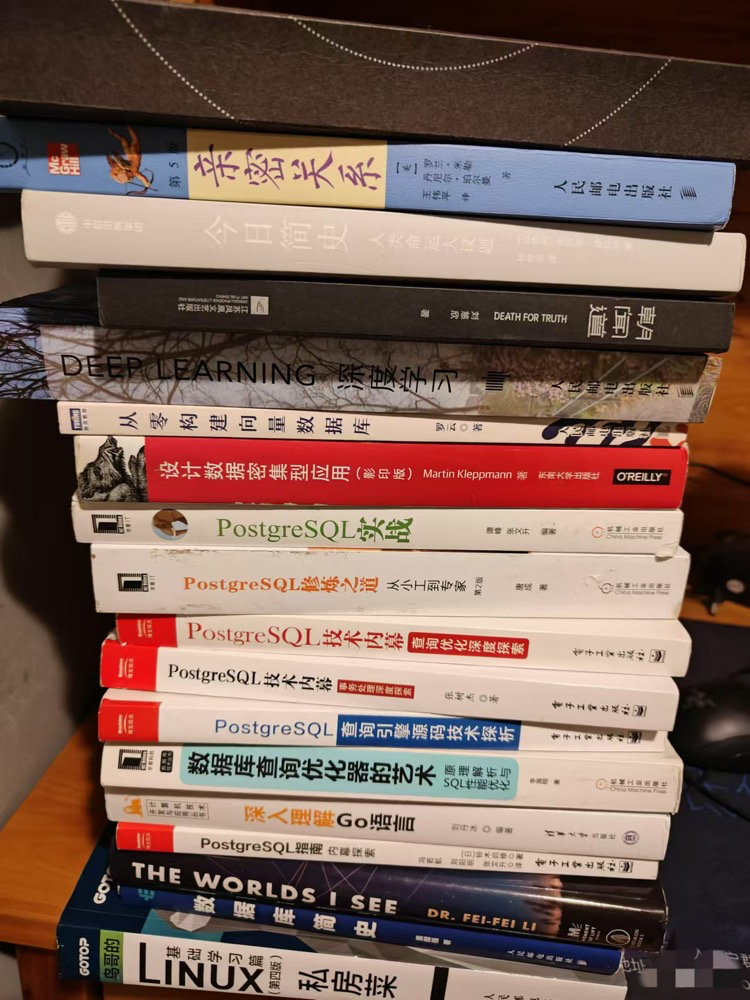
Let me reiterate why I’m so devoted to reading (I said this in 2023 too…):
- The value brought by reading is immeasurable in the short term
- Reading brings a pleasant sense of intellectual enrichment
- Learning is a belief. Yuval Harari has a view: believing in science is actually also a form of faith. I choose to believe in this faith, at least in 2024 and the foreseeable future.
My book list roughly falls into three categories: PostgreSQL, broader technical scope, and extracurricular. Some are in Chinese, some in English. Some are physical books, some electronic.
This year, let me continue with a reading list ranking. Horizontal comparison across different categories is a bit of a stretch, so let’s compare within categories. Once again, note: these book lists are for books I aimed to “finish cover to cover.” Books used as references don’t count here.
2024 PostgreSQL Book List (ranked by preference):
- “PostgreSQL Database Kernel Analysis” — clear thinking and framework, though the version is a bit old
- “Quickly Mastering PostgreSQL Version New Features” — this should be my favorite PostgreSQL book this year, because it has zero fluff throughout, a pleasure to read
- “The Internals of PostgreSQL” — I originally wanted to put this first, but since there’s a free online version at interdb, I wouldn’t even recommend buying this book. It’s ranked here because interdb is so excellent — its substitute is enshrined here as a deity
- “The Way of PostgreSQL: From Apprentice to Expert, 2nd Edition” — very detailed but also very long. I recommend skimming through quickly to find the key points without lingering too long
- “PostgreSQL Technical Internals: Transaction Processing Deep Dive” — transactions are the foundation of PostgreSQL, and also the foundation of my source code journey
- “PostgreSQL in Action” — the practical examples are well worth referencing
- “PostgreSQL 16 Administration Cookbook” — not recommended. The table of contents framework looks good, but the content is hollow. Don’t waste time on this book.
2024 Broader Technical Scope Book List (ranked by preference):
- “DDIA-v2: Designing Data-Intensive Applications (2nd Edition)” — so good I don’t know where to begin. So excellent that I specially wrote reading notes (my only book notes article this year). I wish I had found it sooner.
- “A Brief History of Databases” — reading history truly brings insight. The story of databases begins here. Some technical things become clearer in hindsight.
- “ITIL 4 and DevOps Service Management Certification Guide (2nd Edition)” — a classic in IT service management. It elevated my understanding of the operations role — how did these things so closely tied to my work come about? Which parts don’t match reality, and why weren’t they applied? You can grasp many things from it.
- “Cloud Native Kubernetes” — hardcore, another track entirely
- “Docker Deep Dive” — decent for understanding containers and container history. The container knowledge itself isn’t actually that much.
- “Brother Bird’s Linux Private Kitchen” — sorry, I genuinely hadn’t read this classic. Came to catch up. The writing approach is well worth learning from. The drawback is that much of it isn’t useful for my role.
- “Machine Learning” — ranked here not because the book is bad, but because it’s very hard to understand. I gave up about a quarter of the way through. This book showed me the upper limits of my intelligence, and I’m sad about it.
- “Building a Vector Database from Scratch” — if you want to read source code, go to GitHub
- “Deep Understanding of Go Language” — understood nothing at all
2024 Extracurricular Book List (ranked by preference):
- “Cancer Ward” — I finished this early in the first half of the year. While reading it, I felt: barring surprises, this book would rank first this year. Nobel Prize in Literature, well-deserved.
- “Intimate Relationships” — understanding relationships with lovers, friends, and bosses. Academic paper style, solid, I like it.
- “Does God Play Dice? A History of Quantum Physics” — setting aside everything else, the writing style provides immense emotional value, making me want to keep reading. I finished it in just a few days.
- “The Worlds I See” — AI pioneer Fei-Fei Li’s autobiography. The story of a girl who grew up in Chengdu venturing into the melting pot of America, eventually leading Google AI, while also narrating the history of AI development.
- “21 Lessons for the 21st Century” — the final installment of Yuval Harari’s trilogy. I loved the first two books, but this one felt just okay. At least it brought closure.
- “The Old Man and the Sea” — hard to evaluate. I like its temperament, but not its content.
- “The Wandering Earth” — this is a collection of Liu Cixin’s short stories. One day at the library, I bought it because of the first short story. After buying it, I found the other short stories to be very boring and childish. I felt cheated.
- “Journey to the West” — hot take: they can’t even explain Tang Sanzang’s background properly. A mess, completely confused. I gave up after a little bit. (My evaluation of “Romance of the Three Kingdoms” last year was very high.)
Blog and WeChat Official Account#
2024 Published Articles:
- PostgreSQL technical: 21
- Other technical: 2
- Book notes: 1
- Miscellaneous articles: 1
I only wrote 25 articles this year, a noticeable decrease from last year.
WeChat Official Account followers: 600. Though not many, I believe every single one has good taste 😸
Writing technical articles is actually quite tiring — it takes far more time than one would imagine. However, you genuinely learn things during the writing process, and the sense of accomplishment from completing a piece is real. Since I feel responsible for my articles, I won’t write recklessly about things I don’t understand. As for errors arising from misunderstandings, that’s actually normal. No one can guarantee that their future self won’t criticize their current self — just write correctly for the current state.
In terms of writing content this year, I gave up writing reading notes for extracurricular books. I wrote quite a few last year, but writing reading notes takes a lot of time with very low value. Low emotional value tasks naturally get abandoned. In fact, my writing content varies each year. Currently, PostgreSQL database technical articles are the only constant — other types aren’t as stable. This is normal. The blog was originally meant for database writing. If there’s no application scenario for other domains, I won’t touch them again after the brief exploratory period.
One more complaint: domestic blogging platforms only care about article quantity, which is completely at odds with my writing style. Each of my articles is tens of thousands of hand-typed characters. I’m a quality-over-quantity blogger. So I can’t be bothered anymore — I’m planning to abandon CSDN in 2025 and just post on GitHub and my WeChat Official Account.
I’ve been writing on CSDN since 2017. When I first started blogging, there weren’t many good blog hosting platforms. Looking at CSDN now: community interaction is zero, and the vast majority of articles on it are terrible. Even I don’t want to find CSDN articles myself. It’s like a first love of 7-8 years — sometimes you just have to break up.
2024 Publication Channels:
- CSDN Blog: https://liuzhilong.blog.csdn.net
- Modb.pro: liuzhilong62
- GitHub: https://github.com/liuzhilong62/blogs
- WeChat Official Account: PostgresCool ()
Expected 2025 Channels:
- GitHub: https://github.com/liuzhilong62/blogs
- WeChat Official Account: PostgresCool ()
- Other platforms: we’ll see
Final Thoughts#
I seem to talk about work-learning balance every year… Due to a dramatic increase in workload this year, there was even a period where I couldn’t study at all. Balance has been shattered. Not having time to study is unacceptable to me, so I later adjusted my daily schedule (thanks to “Atomic Habits” — I absolutely love this book), and finally managed to squeeze out some study time. Actually, as long as no one’s around, learning efficiency is high.
I’ve collected some quotes I resonated with this year:
- Don’t let others become dependencies in your task chain –heisenberg.liu
- Plans that require execution are generally simple plans –heisenberg.liu
- Things not implemented equal things not done –somebody
- Solve problems yourself instead of waiting for others to reply –somebody
- Important things should be done immediately — waiting even a moment means they won’t get done –somebody
- Don’t do repetitive low-value tasks. Think more about the context behind this requirement –heisenberg.liu
- Don’t sift through garbage for gold. Find ways to get quality information sources –somebody
- SREs need the ability to configure optimal default parameters and the ability to modify these parameters in bulk –“Enterprise Cloud Computing”
- The more miscellaneous tasks you do, the more miscellaneous tasks come your way –heisenberg.liu
- SREs spend 50% of time on operations and 50% on development –“Enterprise Cloud Computing”
- Premature optimization is the root of all evil. Premature code abstraction is also the root of all evil –somebody
- The speed at which the human brain receives knowledge is limited –somebody
- If someone won’t let you read, leave that person or leave that environment –heisenberg.liu
- Teams that build knowledge bases are slackers –somebody
- The value of a standard is determined by the customer –“ITIL 4”
- Heroism: working long hours and troubleshooting alone. Long working hours also lead to burnout with the work itself. Those who want to be heroes are only interested in their own achievements and turn a deaf ear to team collaboration –“ITIL 4”
- Not all problems need root cause analysis. It depends on the frequency of occurrence and the scope of the failure –“ITIL 4”
Looking back at the plans I set for myself in 2023: only 2 items total, and I completed neither. KPI achievement rate: 0% 😄
Combining agile operations, agile project management, and OKR thinking: setting a full-year plan for myself at the beginning of the year is simply unreasonable. Looking back at last year and the year before, some of my plans emerged mid-way and won priority battles over other tasks. And some tasks simply couldn’t be completed — this should be a normal state. So, I won’t set too many flags for myself.
2025 Plan:
- Continue some things
- Think about how to produce output
- Master another track
- PostgreSQL… haven’t figured out what more to do
- Find a way to resume fitness