
Why Did I Want to Pursue a Part-Time Master’s?#
- To improve my academic credentials. My undergraduate degree is from an ordinary university. A higher degree can add a bit of competitiveness in my career.
- I once submitted my resume to a state-owned enterprise and was completely ghosted. But a colleague with better academic credentials in the same office got through. So for state-owned enterprises, higher education is the knock on the door.
- To make up for failing the graduate entrance exam as a senior and revive the dream of graduate studies.
- Learning is never wrong — this is my creed.
Differences Between Full-Time and Part-Time Graduate Programs#
Study Mode#
Full-time means you quit your job; part-time allows you to keep working. This basically locks in part-time as the only option for most working people.
Exam Scope#
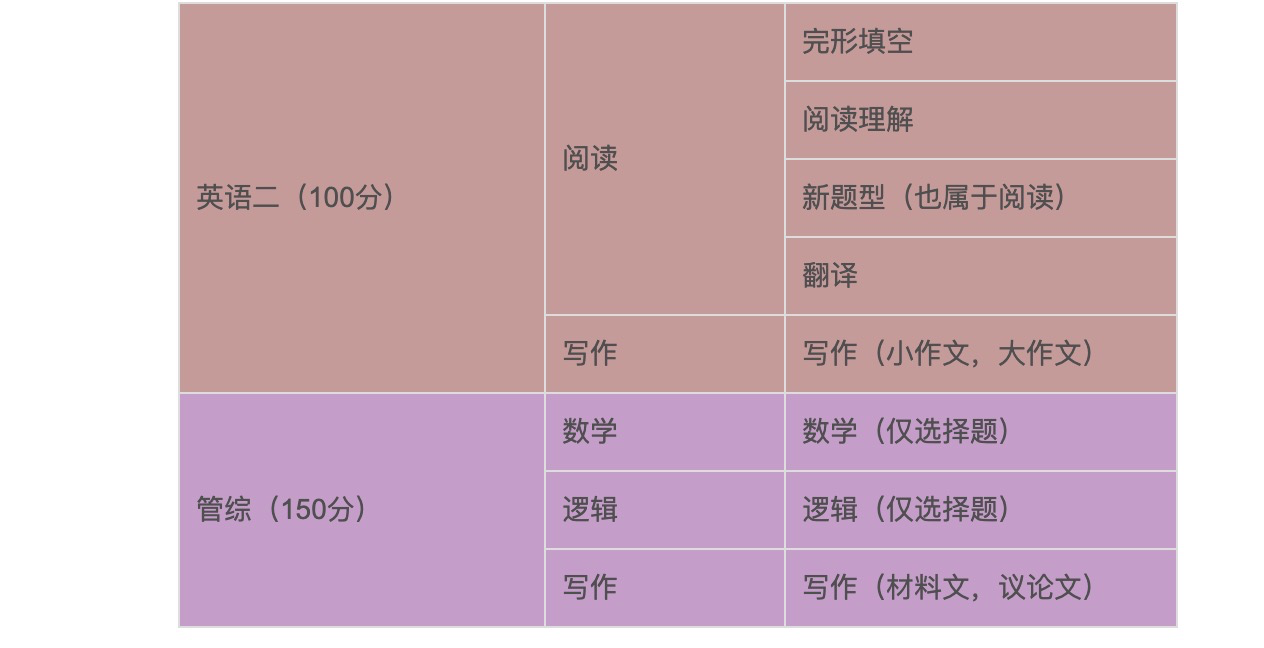
Full-time exams are more demanding, usually covering four subjects: advanced math, graduate English, politics, and a specialized course. Part-time exams are less demanding, covering two subjects: the Management Comprehensive Exam (middle school math, logic, writing) and graduate English. Except for English, which is similar to the full-time version, the management comprehensive exam content is much easier than the full-time track (more on this later).
Research Direction#
Full-time graduate programs lean toward research, emphasizing learning and research output, cultivating students’ learning and research abilities.
Part-time programs lean toward enhancing students’ management skills, delivering management-oriented talent to society.
These two directions are quite different.
Social Recognition#
Full-time graduate degrees certainly carry more recognition than part-time ones. After all, the bar is higher, the study pressure is greater, it’s the mainstream path, and society recognizes it more. But part-time degrees do carry recognition too — many schools have explicitly stated they treat both equally (on paper). Most importantly, part-time graduate students hold dual certificates (degree certificate and diploma).
As for employment, it depends on the employer. Some positions only require any graduate degree, while others may explicitly state “full-time graduate degree required.” But for those who can’t quit their jobs to pursue higher education, part-time is practically the only path. In summary: Part-time also grants dual certificates, but part-time recognition < full-time recognition.
How to Choose a Major#
Consider your job nature, career aspirations, and your wallet.
HR, finance, or corporate executive: MBA
Technical roles or engineering management: MEM
Civil servant or public administration: MPA
Accounting: MPAcc. There are a few other niche options — search online.
From a financial perspective, tuition varies by school but generally follows similar ranges. Taking Sichuan University as an example: MEM costs about 15,000 yuan per year, MBA about 150,000 yuan per year, MPA roughly similar to MEM.
For an IT professional like me, with a thin wallet and not seeing myself as an executive, MEM is the better fit.
How to Choose a School#
Since the study difficulty is relatively low and social recognition isn’t as high as full-time, I recommend choosing a prestigious local university. 211 and 985 universities are strongly recommended — just pick one you like. Many 985 universities set their admission cutoff at the national line, so I personally feel that non-211/985 schools aren’t worth applying to. If the scores are the same, why not choose a better school?
Of course, some 985 universities set their own cutoff lines. You’ll need to check the school’s department website for historical admission scores. For example, Sichuan University sets its own line every year, typically 20–30 points above the national line.
How Does the Exam Work?#
Exam Content#
The exam is divided into the preliminary exam and the re-examination. The preliminary exam is in late December; the re-examination is in March.
The preliminary exam is a written test. After registering for the exam and selecting a test venue, you take it in late December — finished in one day, each session 3 hours.
The re-examination is an interview. A few schools add a written component, but since the pandemic, it’s all been online interviews — rarely do you need to write anything during the interview.
Preliminary exam content (Management Comprehensive Exam):
Re-examination content:
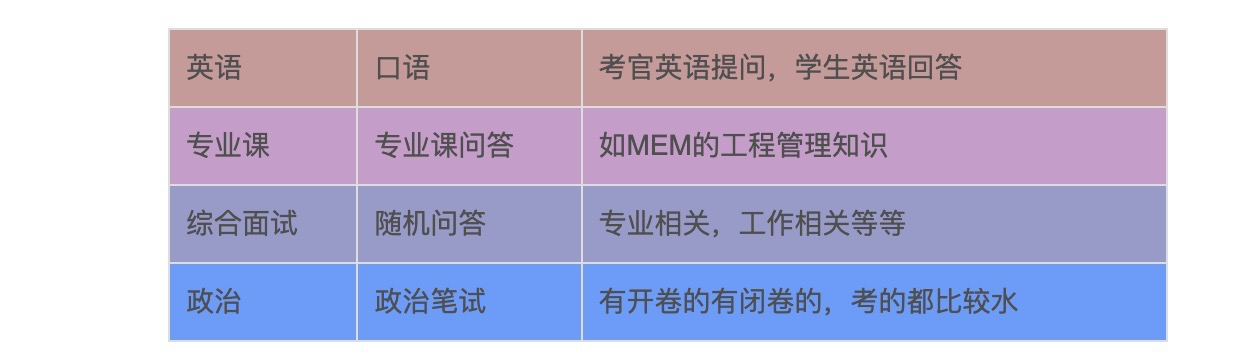
Early Interview#
The early interview means the school arranges an interview before the preliminary exam — effectively moving the re-examination earlier. Once you pass the early interview, you only need to reach the national line on the preliminary exam. Under the normal process, you’d need to exceed the school’s own cutoff line.
Early interviews are only offered by some schools. For example, Tsinghua has an early-admission interview; Sichuan University doesn’t. You’ll need to check the official website of your target school.
If you pass the early interview, the pressure on the preliminary exam is indeed lighter.
How to Register#
The two most important websites in the graduate exam process are your target school’s official website and the China Graduate Admission Website, YanZhaoWang (YZW).

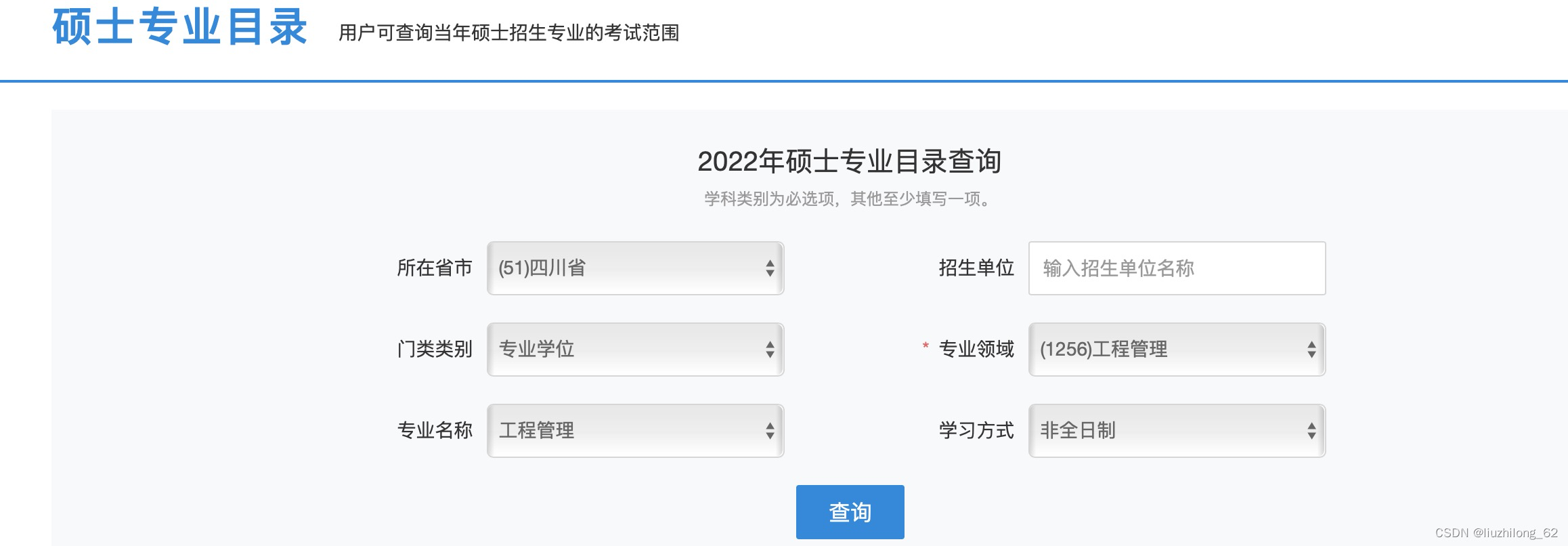
Before registering, check the master’s program catalog for your target school and major. For example, part-time engineering management should be selected as follows:
Should You Sign Up for a Training Course?#
Many people wonder whether to sign up for a training course. Signing up feels too expensive — what if you don’t pass? Not signing up means you don’t know how to study, or studying feels too exhausting.
I have some authority on this question, because I did sign up for one.
I saw a training course online and asked about the price — 8,000 yuan. On top of that, there was an information gap: I didn’t know what the exam covered, how to study, how to register, which school to apply to, or where to search for this information. (Searching “part-time graduate” on Baidu immediately yields nothing but ads.) Plus, I was genuinely determined to study at the time. So I fell into this trap…
What Did the Training Course Give Me?#
First, a pile of study materials — study methods, past exam papers, and so on. Other than the English vocabulary list, which I immediately started memorizing, I barely touched anything else. I printed the past exam papers too, but I never looked at them — not even by the time the exam was over. They looked useful, but in reality, you can search past papers on Taobao and find plenty of officially published versions with detailed explanations — far more useful and less straining on the eyes. And that vocabulary list — strangely, the one the course gave me didn’t match the one in Zhang Jian’s Yellow Book. I memorized the course’s vocabulary for a long time, only to find that some common exam words weren’t in the list. Later I switched to Zhang Jian’s Yellow Book vocabulary and it felt much better.
Beyond study materials, the most important component was live-streamed lectures, typically 8–10 PM — two hours of teaching and ten minutes of Q&A.
The live lectures were useful, especially logic and math. Just listening to those two subjects essentially eliminated the need to buy extra books to thoroughly study the fundamentals of math and logic — you only needed to do the post-class exercises and practice problems. I barely listened to the English classes; I mostly self-studied. Personally, I felt that listening to English lectures was very inefficient and a waste of time — better to memorize more words and do more reading exercises. I only listened to the last two sessions of English writing, which were extremely useful. More on English writing later (with practical tips). Finally, don’t fantasize about asking the teacher questions — these online classes have many students, and the Q&A time is only about ten minutes. My questions were never picked.
Benefits of a training course: Convenience of learning. From a working person’s perspective, you’re already working overtime a lot. Coming home exhausted, expecting yourself to spread out materials and study like it’s the gaokao — too hard. But if it’s a lecture, you just sit on the sofa and watch the livestream. That’s much easier. Saves time. No need to laboriously make a study plan and constantly adjust it. Listening to lectures is also easier than reading through a thick textbook on your own. Essentially, a training course is trading money for time.
The good learning state of classmates motivates you. You’re not studying alone with no idea how others are doing.
The pitfalls of training courses: Quality varies widely. The institution I signed up with was Shangde. I didn’t research them beforehand — they were quite mediocre. Some of their programs are contract-based: they refund if you don’t pass, but there were traps in the contract, and no one got refunds. Our group had many people fighting for refunds. Also, personal information leaks — basically every student received refund scam calls. Even I, who passed, got five or six such calls.
Teacher quality is uneven. Some teachers were excellent; others seemed like they were just coasting. Some explanations were outright misleading. In my class, the math and logic teachers were especially good, English was garbage, and writing was misleading…
Don’t fantasize that a training course will train you into a great candidate. The course is only an aid — it mainly depends on you. From the day I started planning for the exam until the preliminary exam was over, I had basically zero weekends — every one was spent in the library or a café. I declined every social gathering.
So, should you sign up for a training course?
I think if you meet all of the following conditions, you can consider it:
- Enough resolve. Since you’ve paid, don’t let it go to waste. I also don’t recommend refund-based programs that give you an escape route.
- Enough money. Online courses start at a few thousand yuan — my 8,000 yuan can serve as a reference. In-person courses are more expensive but offer face-to-face tutoring.
- Unable to bridge the information gap. The information gap may prevent you from planning your own study schedule. If the information gap is what drives you toward a course, I suggest looking at others’ study plans and successful Bilibili uploaders’ cases. The biggest source of information is always the school’s official website.
If you have the time, energy, insufficient funds, or decent learning ability, you absolutely don’t need to sign up. In that case, making a study plan that suits you is especially important.
The Preliminary Exam#
Before the preliminary exam is over, focus only on preparing for the preliminary exam. Generally speaking, you can prepare for the re-examination content after the preliminary exam is done. Preparing for the preliminary exam is the core of your studies, the most energy-consuming and competitive phase — this is where success is decided.
How to Prepare for the Preliminary Exam — Study Plan#
To prepare for the preliminary exam, you need a study plan that fits you, and you need to throw yourself into it completely.
The study plan is extremely, extremely, extremely important. You need to first examine yourself — what are your strengths and weaknesses, your circumstances, which subjects you’re unfamiliar with, and which ones need long-term study.
Everyone’s situation is different. Let me first share my study plan — you can reference my approach to customizing a plan and my study methods. Because the pressure isn’t as high (compared to full-time), I strongly recommend starting in July or August. Starting too late means not enough time; starting too early makes it easy to slack off. Total study time should be 5–6 months. But if your English is really poor, start memorizing words a few months earlier.
My personal conditions:
- Not enough time — often worked overtime until 9 PM, weekends generally off. Commute by subway, two hours total both ways.
- Math almost completely forgotten, never touched logic before, Chinese writing has been terrible since childhood, decent English vocabulary, reading comprehension fine, English writing completely unable.
Given the study pressure and my personal conditions, my plan needed to be:
- Memorize words. English is definitely the most time-consuming — it requires sustained, long-term vocabulary memorization. Before all other studying, memorize English II vocabulary. Since morning memory retention is best, I memorized words on the subway to work every day and also on weekend mornings. From August until the preliminary exam.
- English reading. Actually, once you’ve memorized the words, reading comprehension is easy. English II doesn’t have many long, complex sentences — if you know all the words, reading is no problem. But I personally enjoy English reading, so I scheduled daily reading of English originals. I can’t say it had a huge impact, but it wasn’t useless — consider it a supplement to exam prep. Importantly, hobbies make habits easier to form.
- Math and logic have similar study difficulty. Even though I was completely clueless, they were relatively easy to learn (the concepts are simple; the exam itself is another story — but more on that later). I studied math or logic from 8 PM to 10 PM on weekday evenings (mostly attending lectures — if you don’t have lectures, buy materials and self-study). This is also long-term study: early phase learning concepts, late phase practicing. Since I couldn’t always leave work on time, sometimes I had to use the evening commute and the one-hour lunch break to complete the daily math and logic tasks. (Never fall behind — one day of delay leads to a huge backlog.)
- Chinese writing. Prepare about one month before the exam — late November or early December. Look at writing materials and try writing yourself. Don’t aim for perfection — the main thing is to express the core idea clearly. Trust me, during the exam you’ll absolutely be writing in frantic cursive.
- English writing. Prepare about one month before the exam. Remember: absolutely, absolutely do not memorize model essays. Not only is it brutally hard to memorize them, they’re nearly impossible to adapt. Memorize 2–3 templates before the exam, then practice with past exam topics using the templates. You only need to swap in words — no situation where you pick up the pen and can’t write a single word.
So, my weekly plan:
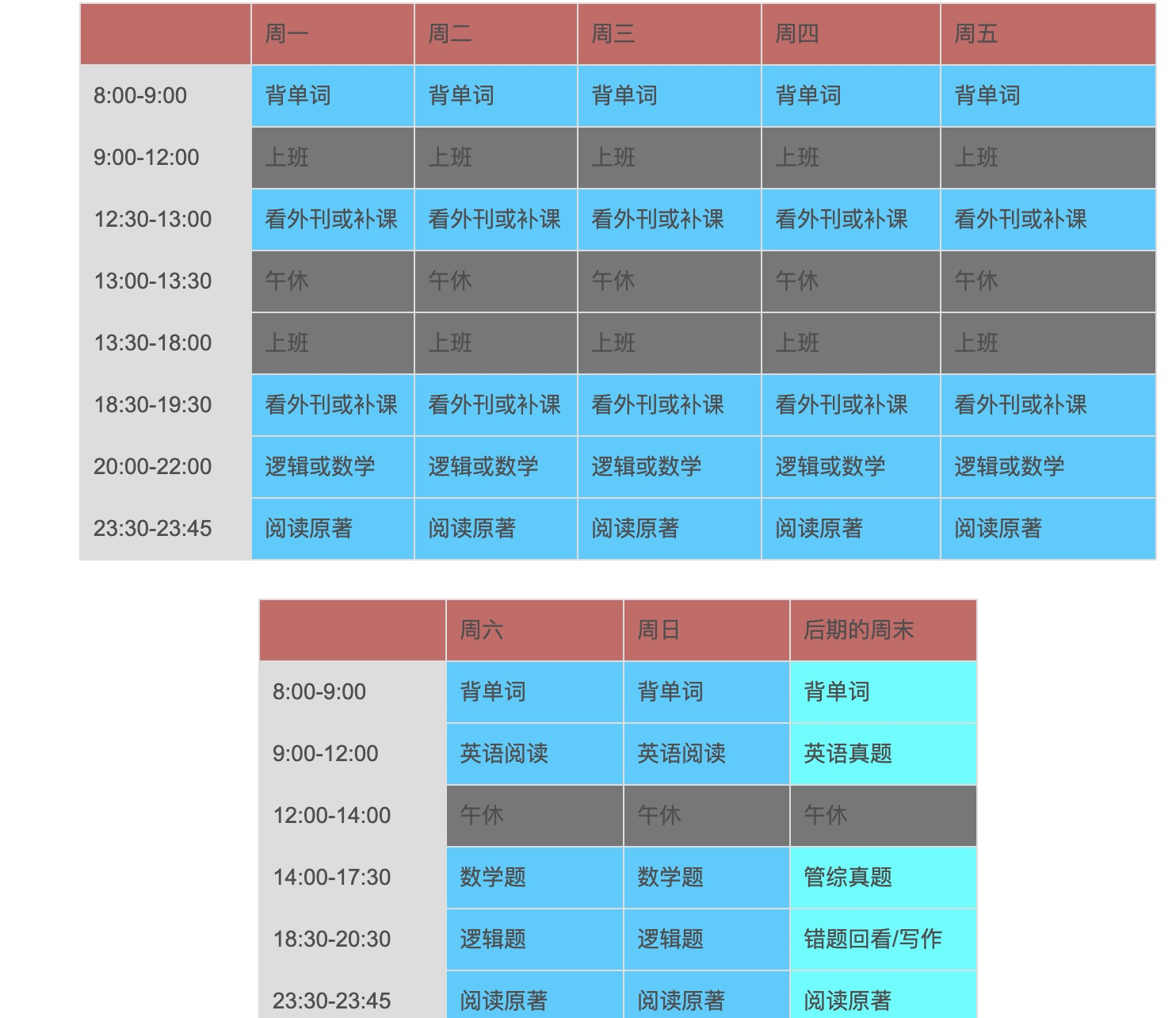
This arrangement felt quite suitable for me — it fully utilized fragmented time and made good use of weekends. The first 3–4 months build the foundation: English’s foundation is vocabulary, logic and math’s foundation is concepts. Weekly study on workdays could be consolidated and practiced on weekends. The final 1–1.5 months are mainly for writing and getting the feel of past papers.
Recommended Study Materials#
- English: Zhang Jian’s Yellow Book. Just buy the vocabulary book and past exam papers. Baicizhan (vocabulary app), iReading, WeChat public account: Graduate English Foreign Journals (English journals for grad exam prep).
- English writing: I don’t recommend any purchasable writing guide. Use universal templates; don’t memorize model essays.
- Math: Chen Jian’s Math High Score Guide, past exam answer keys.
- Logic: Zhonggong’s Logic Easy Pass, past exam answer keys.
- Management comprehensive writing: Buy a popular one — they’re all not great. No need to master writing too deeply.
Don’t buy practice problem books — buy past papers directly. The quality of existing practice problems doesn’t compare at all to past papers. For English, no need to buy practice books — directly buy past papers. For math and logic, beyond the built-in exercises that come with foundational study, don’t buy extra practice problem books. I did math practice problems for a short period — very time-consuming and ineffective. The key for math and logic is to solidify the fundamentals, cover all the concepts, then do past papers and review the answer explanations. In short, immersive study time (like weekends) should only be spent on past papers. Do the last 20 years’ worth of papers, then cycle through them again. (20 sets of past papers — only 2 per weekend — takes over two months to finish one round; by the time you redo them, you’ve largely forgotten the earlier ones.) Always save the most recent two years’ papers untouched — use them for timed self-testing two weeks before the exam.
English Study#
Vocabulary#
Morning vocabulary memorization, rain or shine (it works especially well on the subway…). Baicizhan — some people like using it. I used it early on too, but I found it ineffective. It covers the entire vocabulary pool; after a year you may not even complete one full cycle, and you’ve long forgotten what you studied earlier. So I stopped using it later. I strongly recommend my personal vocabulary method.
Everyone’s vocabulary is different. At the start, you must go through all the words once (graduate exam vocabulary is about 5,000 words) and pull out the ones you don’t know onto a vocabulary list. Since carrying a vocabulary notebook on the subway is slightly awkward, I put it on my phone.
I have a dedicated vocabulary photo album:
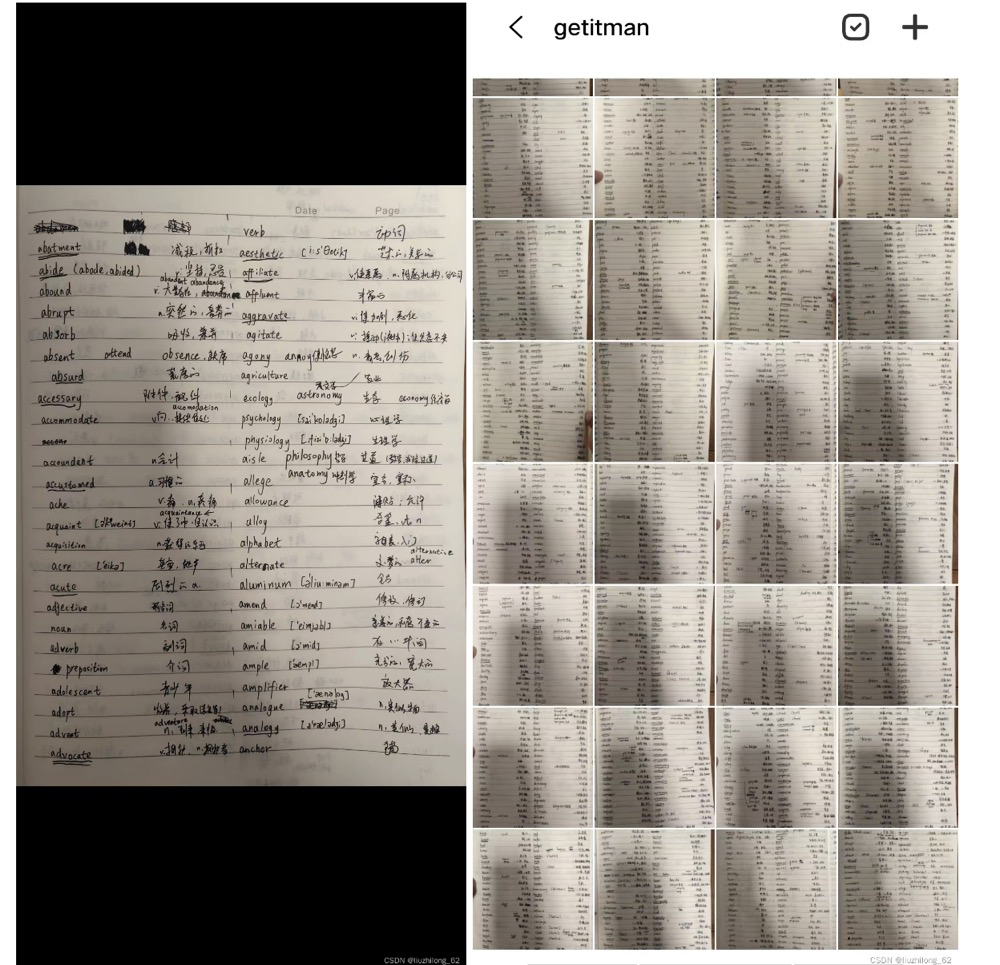
When memorizing, open it, zoom in — effectively covering the definitions while memorizing.
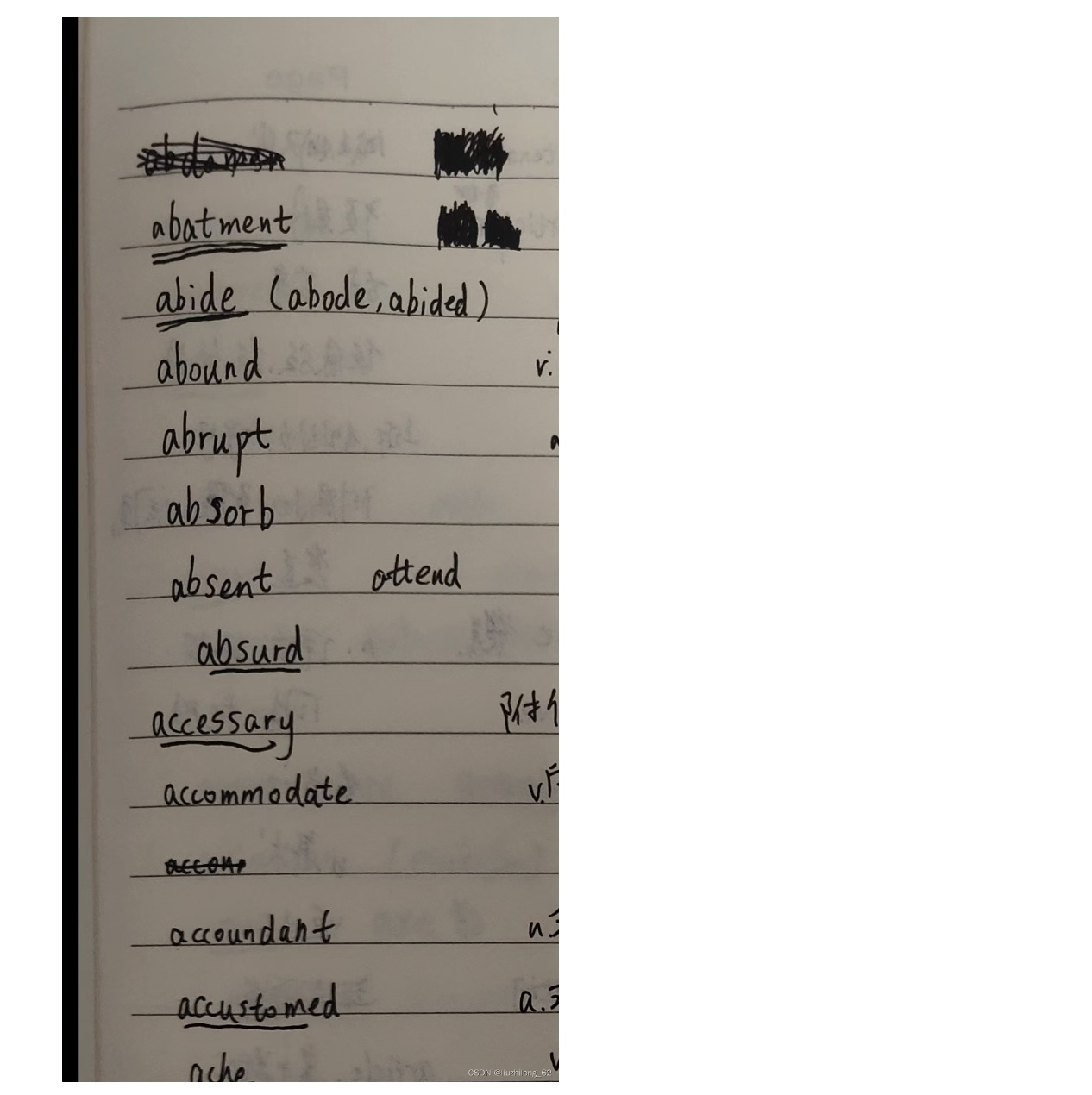
Cycle through like this. At first I did 2 pages a day, advancing 1 page a day. Later, 4 pages a day, advancing 4 pages a day. No matter what, cycle through — memorize until you can cover the definition and know the word’s meaning. For words easily confused, add them to the list, take another photo, and update the album.
Before my preliminary exam, I had cycled through these words six or seven times. Basically, aside from beyond-syllabus words, there was nothing I didn’t know.
Reading#
English total score: 100. Reading ability components = Cloze 10 points + Reading Comprehension 40 points + New Question Type Reading 10 points = 60 points. No matter how poor your English ability, reading comprehension cannot be weak. My reading ability mostly came from daily foreign journal reading, such as iReading and Graduate English Foreign Journals. About 20 minutes a day, light study pressure. (Actually, it’s mainly vocabulary — if you know the words, sentences are easy to understand.)
- iReading: “Love the World” foreign journals, one passage a day. Under Reading Plan → More Collections → Foreign Journals → Love the World, subscribe to the monthly issues, one a day. Relatively easy, good for early-stage reading improvement.
- WeChat public account: Graduate English Foreign Journals, one passage a day. Updated daily. This account is very well done, highly recommended. Just harder — good for later-stage challenge. If you don’t fully understand, that’s fine; I sometimes couldn’t fully grasp it either, since the difficulty is a bit high.
Read along with morning vocabulary memorization. If short on time, you can also read on the way home.
Long and complex sentences: English II doesn’t have many. Some people dedicate time specifically to studying them. If you want to study long sentences specifically, I especially recommend Liu Xiaoyan’s Long Sentences video series (just search on video sites — they’re all free). It’s very engaging and well-organized, easy to stick with. As for me, I only watched the simple sentence part of Liu Xiaoyan’s course and stopped. Because, first, I found that as long as you know the words, you basically understand the sentences; second, the videos are too long and numerous, taking up too much study time.
Writing#
Writing is divided into short composition (letter or notice, 10 points) and long composition (data analysis essay — bar chart/pie chart analysis, 15 points).
Again, do NOT memorize model essays. Before the exam I bought a writing book and memorized 10 model essays — truly, truly excruciating to memorize, and impossible to adapt. After memorizing the model essays, the first time I attempted an English writing question, I couldn’t write a single word — no exaggeration.
The most valuable thing in my training course was the English templates. Using the templates, I worked through all the past years’ English writing topics — every single one could be adapted. The number of words to swap in doesn’t exceed twenty; you just need to be able to write simple sentences. Here are the templates:
Short composition template — Letter:
Dear  Sir or Madam,

    I am an undergraduate who majos in Applied English in this/a university.I am writing this letter for the purpose of doing sth.

    1.It,first an formost,is my idea that not only ... but also

    2.Then more importantly,so ... that...

    3.The last on I must point out is that Simple sentences,which could be accepted by the majority of people/.

    So It is the very moment for me to do ...,And I am looking forward to your reply.

                                                                                    yours truly,
                                                                                     xxx.
Where “doing sth” includes:
1.Thank-you letter:expressing my genuine gratitude for your kind help
2.Suggestion letter:making some suggestions concerning sth.
3.Complaint letter:making my complaints concerning sth.
4.Congratulation letter:show my sincere congratulations to you because sentence
5.Apology letter:offer my sincere apology to you because sentence
6.Invitation letter:invite you to participate in event on behalf of someone/organization
7.Notification letter:have someone informed that sentence
The letter template works for all types of letters.
Besides letters, the short composition may — with low probability — test notices. The notice format differs from letters.
Short composition template — Notice:
                                        Notice

    In an effort to do sth,I woud like to offer you some detailed information about it.

    The event will be held in the school auditorium at 7 p.m.,next Saturday,December 28th and the requirements for sth. are listed as follows.

    Body content same as letter...

    If you have any questions,please feel free to send on email to
[email protected] or call 1234567.We are looking forward to your participation.
The long composition essentially only involves analyzing bar charts and pie charts. The data falls into two categories: comparing magnitudes and comparing trends. Only the first paragraph differs between the two; the latter two paragraphs are the same.
Long composition template:
    (Comparison opening)The diagram clearly shows/illustrates/d that sentence/phrase(the purposes of/attitudes toward/the proportions of) among participants/respondents in a certain college.
Based on the data offered,one can distinctly see that object1 ranks the first/highest among all the categories,accounting for data1.Next are object2 and object3 with data2 and
data3 respectively ,while object4 only constitutes data4.
    (Trend opening)The diagram clearly illustrates how topic changed during the past several years.Based on the data provided,one can distinctly see that the number of object1 rose/fell significantly/slightly/gradually from data in year to data in year,while that the number of object2 experienced a gradual/significant increase/decrease during the same period,reaching data in year.
    From my standpoint,there are two fundamental factors that are responsible for this scence.To begin with,the first contributing factor is that sentence.In addition,another important factor that cannot be ignored is that sentence.
    In view of the analysis above,we can conclude that it is of little surprise to see this phenomenon in the current era.Therefore,it can be predicted that noun phrase/verb-ing will still take up a large share in the future.
Writing without templates — relying on your own ability — is extremely difficult. Getting an ultra-high score with templates is hard, but getting 70–80% of the score is no problem, and the upfront investment is basically zero. After memorizing the templates, just write through all the past years’ writing topics once.
Math and Logic Study#
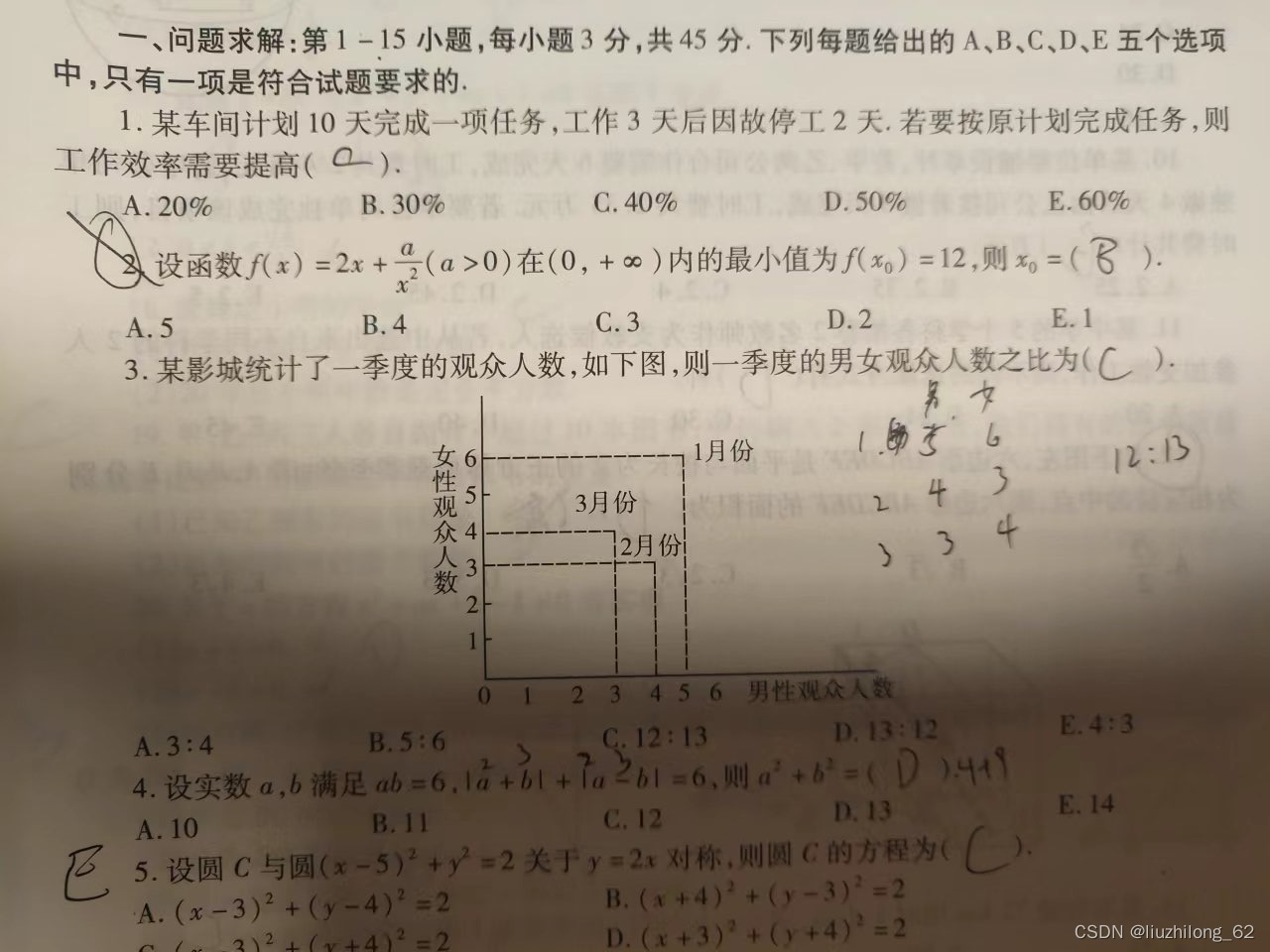
Math questions:#
Logic questions:#
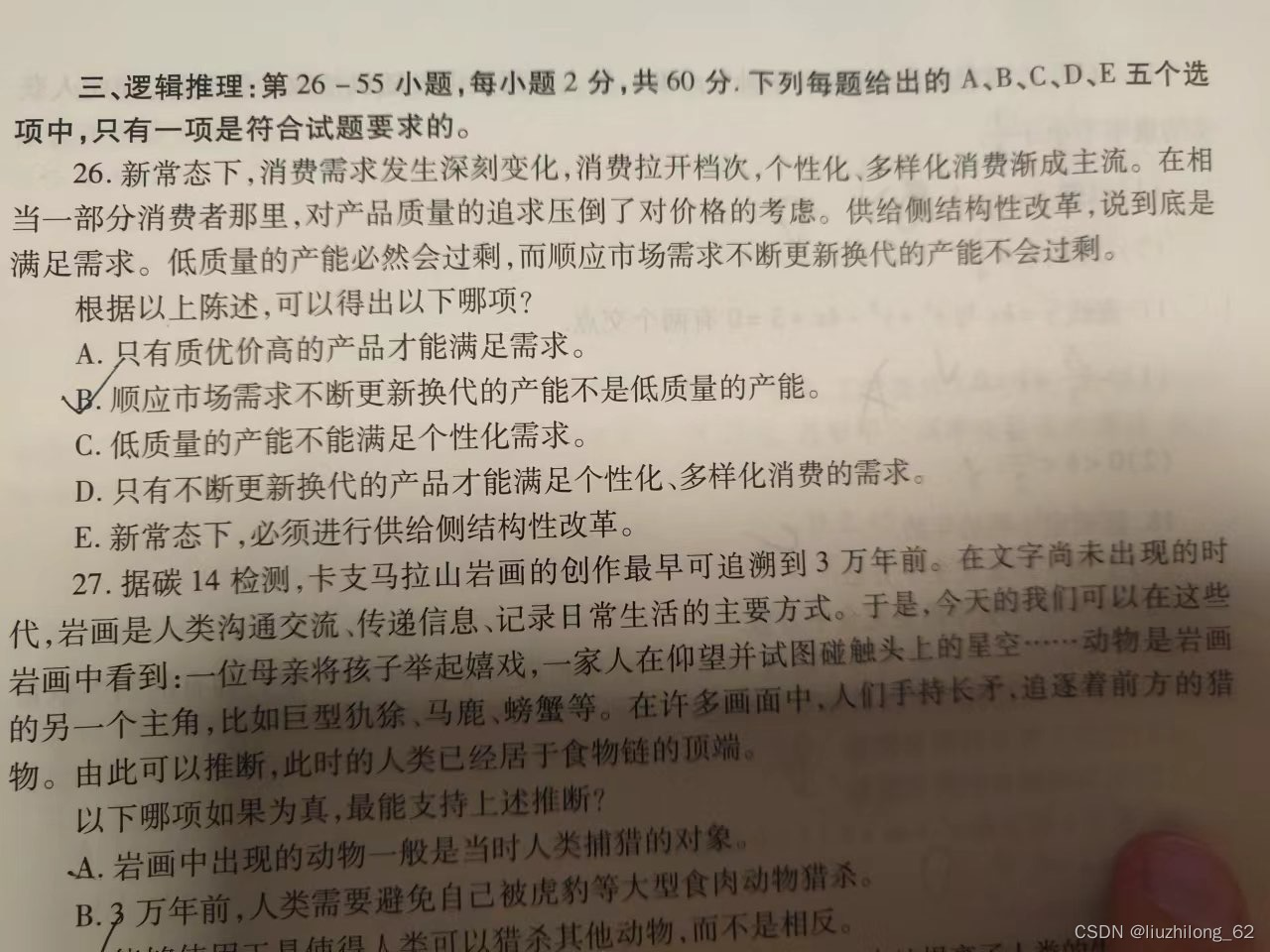
Math and logic are both multiple choice — nothing special to say. Early phase: learn concepts. Later phase: improve speed.
Math and logic have a huge number of concepts. The early study phase takes 3–4 months, 2–3 hours a day, to learn all the concepts. After mastering the concepts, practice with past papers and review answer explanations. In the final month, practice with a stopwatch to improve speed: math questions within 70 minutes, logic within 60 minutes.
Chinese Writing Study#
The management comprehensive essay is divided into Argument Validity Analysis and Argumentative Essay.
Argument Validity Analysis is essentially nitpicking — get a writing guide and look through it; it’s not hard. You need to find the logical flaws in a lengthy passage of material. When writing, find four problem points. If you haven’t studied it, you might struggle to find them; after studying, finding four points is fairly easy. Don’t worry about naming the flaws precisely — overgeneralization, equivocation, false dichotomy, etc. Just write “xxx does not lead to xxx.”
The Argumentative Essay mainly involves interpreting a short passage. The key is not to misinterpret the theme. Finding the theme is also challenging at first — look at more sample materials to get a feel for it; generally you can locate the theme. The standard structure is introduction-body-conclusion. I recommend using “individual – enterprise – nation” as the framework (intro – individual – enterprise – nation – conclusion, 5 paragraphs total). Pick a few tried-and-tested points to plug in. Some students with strong writing skills write argumentative essays using other approaches — I certainly admire that. But writing time is extremely limited. Unless you’re naturally gifted with lightning-fast thinking, I recommend using a formulaic approach. Finishing the essay is the top priority.
Exam Time Strategy#
Yes, you need to strategize the exam timing too. Trust me 100% — you will not finish the management comprehensive exam. It’s the most time-crunched exam I’ve ever taken. You know you can solve the problems, but you have no time to compute.
On exam day: morning — management comprehensive, 3 hours. Afternoon — English, 3 hours.
English: 3 hours, relatively little content, no need for repeated recalculation — time is completely sufficient. When I finished, I had 50 minutes left and left early.
Management comprehensive: 3 hours, absolutely not enough. In my pre-exam self-timed simulations, I consistently took 4 hours. During the real exam, for math — any question over 3 minutes, skip immediately. If it feels computationally heavy, skip immediately. For logic — absolutely cannot use your usual analytical approach. Speed-read the question (logic questions have colossal amounts of text), look at the options, pick whatever feels right. Logic questions requiring computation: temporarily abandon, come back later if time permits. For writing — read the prompt and start writing immediately. Write as fast as you possibly can (both essays combined no more than 1 hour). Every 2 minutes saved could rescue a multiple-choice question.
You don’t have to finish all the multiple-choice (do fill in the answer sheet completely though), but you MUST finish the writing. So the question order is important. Many people do the essays first, then multiple-choice. I did math first, then essays, then logic. Either way, don’t leave writing for the end. In the real exam, both essays must be finished within 55 minutes — 1,500 words total, plus reading the prompt and brainstorming. Try it once and you’ll know how impossibly short the time is.
The last 20 minutes: fill in the answer sheet. After filling it in, continue solving problems.
The Re-examination#
Basic Information About the Re-examination#
If you’ve made it past the national line or the school’s own cutoff — congratulations, you’ve completed 90% of the journey. The remaining 10% is the re-examination. The re-examination has a mandatory elimination rate (required by national policy), typically around 70–80% passing rate. Since elimination must exist, some people get cut every year. If you don’t prepare, you’re very likely to be among them. Here’s a joke: I got cut from Sichuan University’s re-examination~
Re-examination timeframe: mid-to-late March each year.
Score release: mid-March.
Content: spoken English, specialized knowledge, comprehensive interview, politics (Sichuan University: open-book politics, no need to prepare. Wuhan University: closed-book written politics…)
Since the pandemic, re-examinations have been online interviews — no written test environment. Experts ask questions; you answer.
So you have three months to prepare for the re-examination. Conveniently, the preliminary exam ends late December, scores aren’t out yet, and February is Chinese New Year — realistically, most people start preparing only when scores are released. Take me as a cautionary example: I received the re-examination notice on March 21, the re-examination was on March 27 — I had six days to prepare, including spoken English and engineering management, which I’d never touched before… So it was embarrassing: I couldn’t answer a single one of the examiner’s English questions, couldn’t answer a single specialized question. Cut from the re-examination.
Post-Adjustment (Tiaoji)#
When I found out I’d failed Sichuan University’s re-examination, my mood plummeted. But — every cloud has a silver lining. The adjustment (tiaoji) process was my lifesaver. While searching for adjustment schools, I found Wuhan University.
The China Graduate Admission Website has a dedicated adjustment window, giving students who failed their initial re-examination three more interview opportunities. You can fill in three preferences — three schools to apply to. Since each school has different re-examination dates and requirements, preparing for all of them is very hard. I focused mainly on preparing for Wuhan University’s adjustment. The adjustment, of course, also involves a re-examination — essentially, schools that haven’t filled their enrollment quotas run the process again, giving students who weren’t admitted in the first round another chance.
Adjustment window: late March to early April.
How to Prepare for the Re-examination?#
The re-examination is also highly competitive. Lazy people like me are not uncommon… But no matter what, you’ve already invested over half a year — you can’t let it go down the drain. (I almost did…) For non-specialist students like me, the hardest parts of the re-examination are spoken English and specialized knowledge. From score release to the re-examination, you have about one week (while still working!), so learning from scratch is impossible. Based on my experience, the following approaches, in descending order of importance:
- Find seniors who’ve been through it and get past re-examination materials (discreetly — sharing re-examination materials externally is prohibited) and course materials. See if anyone you know is at that school, or find groups on forums or Tieba.
- Search Bilibili for common graduate re-examination questions. Summarize them and memorize.
- Buy the school’s recommended reference books (usually course materials). They’re thick; you won’t finish them.
Finally, the most important thing: mock re-examination. Summarize potential English questions, specialized questions, and comprehensive interview questions, then find a partner to act as the examiner for a mock interview.
There are other re-examination requirements — keep an eye on department updates and your email: score weightings, interview process, dual-camera setup, interview schedule, document preparation, etc.
The End#
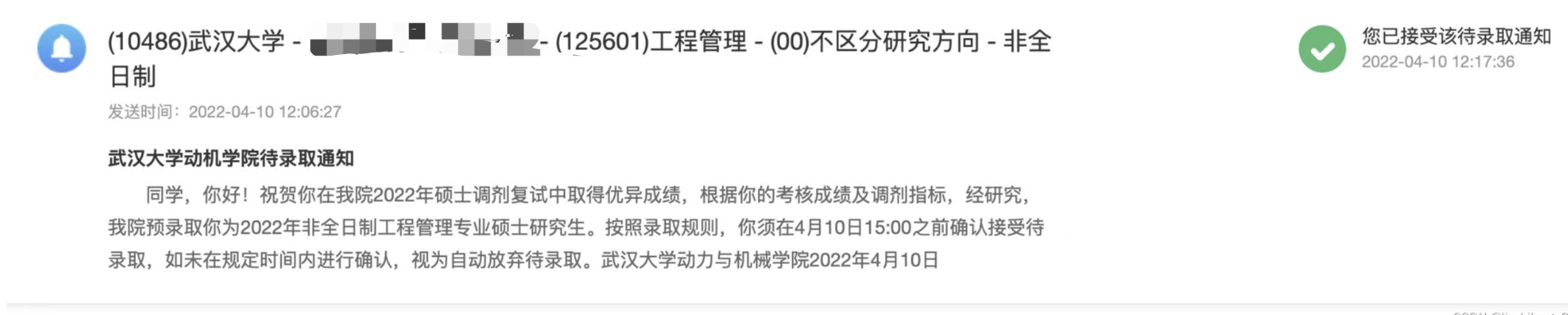
The 2022 national preliminary exam line was 185. My preliminary score was 210 (English 80, Management Comprehensive 130). Here’s my re-examination acceptance notice ^_^
Good luck to all working-student-warriors battered by society but still holding onto your dreams — may your graduate exam go smoothly. You’ve got this!!!