
Rich Dad Poor Dad. I used to scoff at this kind of book. It’s the type of success-literature you see displayed at bookstore entrances, looking insubstantial at a glance, very unreliable — the kind of thing that seems to prey on people at the bottom of society who dream of getting rich quick but can never actually apply the book’s advice due to their own circumstances or environment. Besides, smart people don’t read such uncultured books, right? The title is tacky as hell!
I spent a period watching Lao Gao and Xiao Mo on Bilibili, and one episode talked about this book, making it sound mystical and mysterious. Plus, it’s a global bestseller, so I bought it to see just how magical it really was.
Started Reading E-Books#
I’m a die-hard fan of paper books. I love the feeling of finishing an entire book and placing it on the shelf to collect — that “this whole bookshelf is my knowledge” feeling. I wasn’t really into e-books; they give a “read it and it’s gone” vibe. Three reasons brought me back to e-books:
- I recently deleted all my go-to time-killing apps and needed an app that wasn’t so brain-numbing — something I could open first when pulling out my phone.
- E-books are just more convenient than paper books; you can pull them out and read anytime.
Making use of fragmented subway commute time. Back when I was preparing for graduate school entrance exams, I made a detailed daily schedule that included subway time. Since I’d already built the habit of studying on the subway, I didn’t want to give it up. I recommend my summary of the graduate exam experience: How I Got Into Wuhan University’s Part-Time Graduate Program
I slightly adjusted my old plan — no need to grind vocabulary as intensely anymore — so I swapped in e-book reading. I split subway time into two blocks: morning commute and evening commute.

In the morning, my mind is clear and my mental state is good, so I read technical e-books. These require slow reading, sometimes stopping to think. This is goal-driven reading.
In the evening, my mind is foggy (not really foggy, more often it’s a headache), so I read lighter books — like “extracurricular” books such as Rich Dad Poor Dad. These books aren’t hardcore in content, so I read fast and enjoyably, with a bit of a dopamine-driven reading feel.
Poor Dad and Rich Dad#
Author Robert Kiyosaki grew up in Hawaii. His biological father was a highly educated government education official — the “Poor Dad.” His best friend’s father was a high school dropout with extraordinary financial intelligence — the “Rich Dad.” Poor Dad had higher education but worried daily about loans and bills, while Rich Dad spent every day directing people to create wealth for him. The book has a classic line: “The poor work for money; the rich make money work for them.”
- The mindset of making money: As a child, the author and his good friend came up with many ways to earn money. They once used toothpaste tubes to counterfeit coins — not knowing at the time that making money was illegal — and were stopped by adults. Later, they gathered free books from stores, set up a little library in a spot, and earned money by renting books to neighborhood kids. They stopped after attracting some local unsavory characters. Rich Dad admired their money-making behavior. He believed the difference between the rich and the poor is that the rich are always thinking about how to make money, while the poor are only thinking about how to find a good job.
- On taxes: The poor pay far more in taxes than the rich. Rich Dad paid more taxes than Poor Dad, but Rich Dad’s income was vastly higher. When the US president decided to raise taxes on the rich, they only raised taxes on the salaried middle class — the truly rich were unaffected. The rich have many ways to legally avoid taxes, by understanding how to use the law. For example, the author says in real estate: if you sell a house, the income is heavily taxed, but if you swap houses, there’s no tax. The rich can use this statute to invest in real estate and legally avoid taxes. But the poor can’t escape income tax — the more you earn, the more tax you pay.
- On investing: Investing requires cultivating knowledge in accounting, finance, and law. In short, if you want to make money, you need to develop your financial intelligence. When you earn a big sum, you should start the next investment rather than buying consumer goods. Think of the tables, chairs, jars, bottles, clothes, and household items in our homes — we pay a relatively high price for them, but the moment they’re bought, their value drops to near zero. This isn’t to say don’t buy things — but consider investing your money first, then consider zero-return consumption.
Finally#
The book says our education system cultivates people’s ability to work, not their ability to make money. I strongly agree with this statement, but I still believe in the power of education. The author isn’t telling people to skip education — education is also very important for making money. We need to understand the basic operating principles and rules of this world, and that can help us find suitable ways to make money.
Given the author’s family background at the time, they may have been relatively poor compared to Rich Dad, but for truly poor people, their family conditions were far from poor. I feel my own circumstances haven’t yet reached the point where I can fully devote myself to investment and money-making. If one day I have some spare money and my management, social, and decision-making skills reach a certain level, I might look for ways to make money. For now, I can’t think that far — gotta code well and fill the holes first.
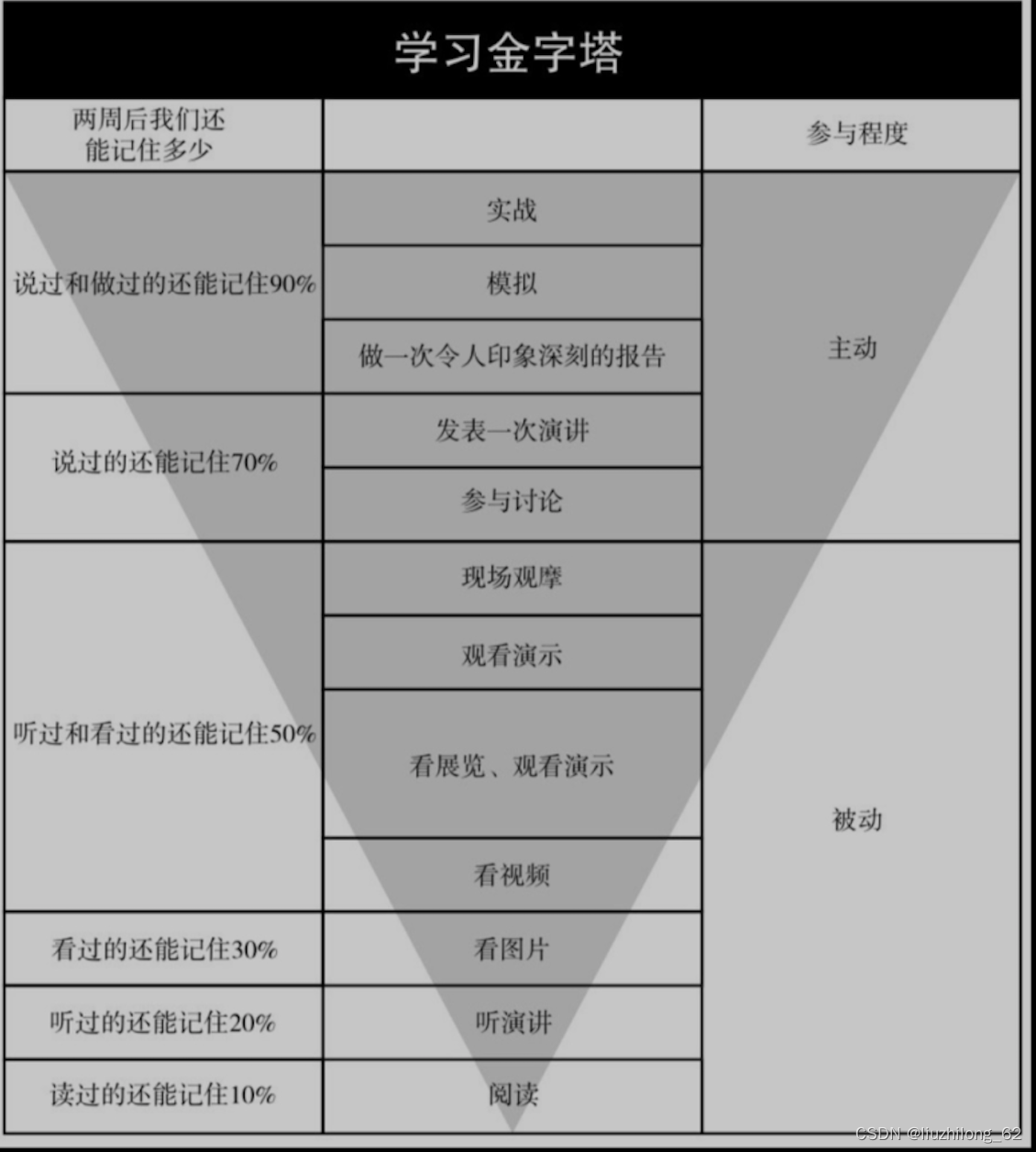
The Learning Pyramid in the book left a deep impression on me. You really retain very little from passive learning. That’s why I persist in writing frequently, including book notes like these. Problems I encountered during years of late-night database maintenance — I still remember them vividly. Hands-on experience truly creates the deepest memories. That said, hands-on experience is unpredictable and rare; reading and self-learning are the lowest-cost, easiest-to-form habits, and the most cost-effective way to improve ability. They’re not that “passive.” The Learning Pyramid’s “passive” refers to knowledge being received by the subject; “active” refers to the subject outputting knowledge. This also strengthens my motivation to record and share — whether technical or non-technical.