
Preface#
An unavoidable work for any sci-fi fan: Arthur C. Clarke’s classic — the Space Odyssey series. The Space Odyssey consists of four volumes: 2001: A Space Odyssey, 2010: Odyssey Two, 2061: Odyssey Three, and 3001: The Final Odyssey. As the titles suggest, the futuristic technological visions take place in their respective years. Don’t think 2001 has already passed — when Clarke wrote 2001, it was 1968! I, at least, can’t imagine what the world will look like thirty years from now, or how far humanity will have advanced in space exploration.
I wrote a reading reflection after first finishing 2001, captivated by its premise, its thrilling space plotlines, its fantastical cosmic backdrop… I immediately dove into the remaining three volumes. I initially expected the setting to expand ever outward, but that’s not what happened. The later three books remain within this cosmic dimension — between Jupiter and Earth — which is already very, very small. They mostly fill in plot details and imagination, bringing the entire story to completion.
The Tetralogy#
2001: A Space Odyssey#
After finishing the entire series, this one still feels like the most classic. Maybe it’s because the plot was the result of discussions with Kubrick…
Since I’ve already written a full reflection on it before, I won’t belabor it here. Interested friends can check out my earlier Book Notes — 2001: A Space Odyssey.
2010: Odyssey Two#
This volume is also brilliant. In the original, China’s spacecraft sent to explore Jupiter is named the Qian Xuesen, and the Qian Xuesen is the first manned mission to land on and explore Jupiter’s moon — Europa — beating the Americans to it! Though the outcome wasn’t great, the plot is thrilling~ Before the Qian Xuesen’s accident, the astronauts described lower life forms on Europa and were ultimately attacked and killed by “extraterrestrial organisms.” This “disaster” plotline sparks infinite imagination: what kind of life exists on Europa? And what should we humans do about it?
Finally, the monolith on Jupiter goes through a series of self-replications and ultimately transforms Jupiter into a white dwarf! Jupiter is ignited! From then on, there are two “suns” in the sky. This premise is just fantastic~
2061: Odyssey Three#
This one feels a bit rushed, mainly because Halley’s Comet was coming. Clarke wrote in the preface that since Halley’s Comet was about to sweep past Earth, if he didn’t release the book soon, the exploration-of-Halley plotline might become untimely. Indeed, a large portion of this volume is devoted to exploring Halley’s Comet. There are some Jupiter-related plotlines, but they don’t advance the main narrative much.
Halley’s Comet orbits the sun once every 76 years. Its next return is about 40 years away (July 28, 2061). Thinking back, its last perihelion was roughly when this book was written — the whole world was talking about Halley’s Comet. (I can feel that no one’s mentioned it in recent years.)
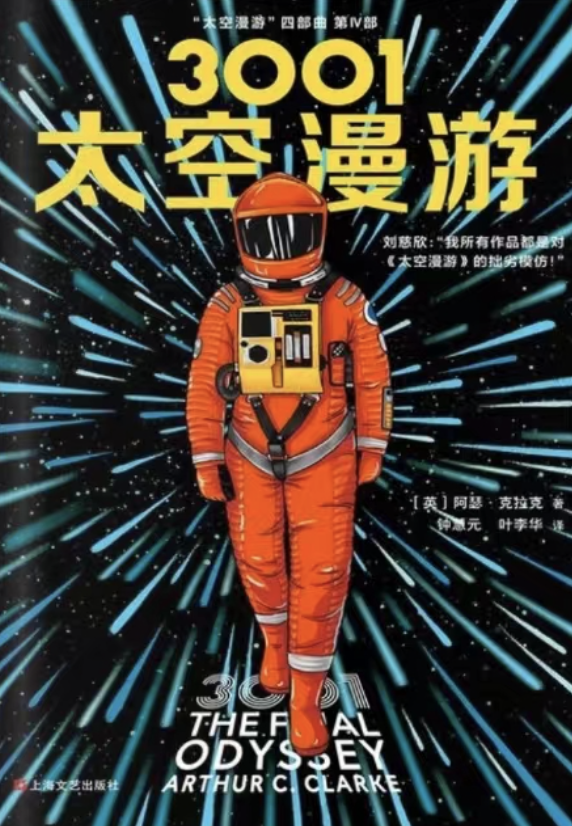
3001: The Final Odyssey#
A perfect concluding work! This conclusion has influenced countless sci-fi novels — you can even clearly sense the shadow of The Three-Body Problem.
The first three volumes are all still in the 21st century. 3001 jumps a full thousand years! Humanity now acquires knowledge through “brain-computer interfaces” rather than learning; the speed of space travel has increased enormously…
But honestly, a thousand years — a thousand years and humanity has only progressed this far? I’d rather believe it was because of the sophons. Huh? Could it be that Old Liu’s sophons were inspired by this exact idea?
The most brilliant part of this volume is humanity resurrecting Poole — an astronaut killed by HAL in the first book. If no one brought him up, you’d assume he was still drifting in space… Resurrecting Poole not only echoes the first book’s plot but also allows us to observe and unveil the human world of the year 3001 through the eyes of an “ancient person.”
The Shadow of The Three-Body Problem#
Or to put it the other way around: the shadow of Space Odyssey in The Three-Body Problem. I tried recalling from memory — apologies for any omissions:
- The Sower — the Singer. In Space Odyssey, the Overlords are “planting” life; in The Three-Body Problem, the Overlords casually “eliminate” life — “What does it have to do with you?”
- Alien warning. “Stay away from Europa” — “Do not answer! Do not answer! Do not answer!”
- Display of alien technology. The Monolith — the Droplet. Both are materials beyond human comprehension, impossibly smooth, artifacts of alien civilizations that humanity’s technology cannot fathom. They represent the vast gap between human and alien technological levels.
- Alien life is coming. We have time to catch our breath, but it seems like nothing we do will matter.
- Resistance plans. With alien beings about to arrive, people begin formulating resistance plans. At this point, humanity still doesn’t know what the enemy truly looks like.
In fact, the two works differ greatly in many ways. Space Odyssey is about cosmic exploration, while The Three-Body Problem is about human society as a whole facing alien civilization. Space Odyssey essentially has only a handful of protagonists, even across a thousand years, and the plot mainly revolves around Jupiter. The Three-Body Problem has a grander scale and far more characters…
Final Thoughts#
I’ve finally finished the Space Odyssey tetralogy. You can truly feel it’s a monumental work of science fiction — it satisfies a sci-fi fan’s longing for the “exploration” of space. Before any space agency had begun exploring “there,” Arthur C. Clarke had already arrived. NASA astronauts would even write back to Clarke: “We photographed the far side of the moon. There were no monoliths, no anomalies” — almost as if saying, “You fraud, I went there precisely because I read your book!” Haha~
Clarke wrote many plotlines about the Qian Xuesen spacecraft in the novels, and in the afterwords of several volumes, he repeatedly emphasized that Qian Xuesen was a person who profoundly influenced the aerospace industry — both in China and the United States. The U.S. arrested him on fabricated charges, and Qian Xuesen ultimately returned to his homeland to build its aerospace program from scratch, influencing missile development. During a trip to Beijing, Clarke even made a special attempt to visit Qian Xuesen, but at the time, Qian’s health was poor, and his doctors wouldn’t permit visitors. Clarke entrusted someone to deliver an autographed copy of Space Odyssey to Qian.
Reading the entire series, you can feel the era’s obsession with space exploration. But after the Apollo program was shut down, people seemed to lose interest in space altogether. However, with Musk’s Mars colonization plans, the theme of “space” seems to be returning to public consciousness. NASA says they’ll land on Mars by 2040 — who knows if it’s true. I’ll come back to dig up this post then.