Preface#
Mention Romance of the Three Kingdoms, and it seems almost everyone can name a few characters or plot points. But have you actually read the original?
I’ve always been a fan of Three Kingdoms-themed games — titles like Bàwáng Dàlù (The Overlord’s Continent) and Total War: Three Kingdoms are among my favorites. I love the feeling of collecting famous generals and rampaging across the battlefield. But thinking back, I realized I’d never actually read Romance of the Three Kingdoms in its entirety. Some of those generic officers in Total War — I had no idea who they were. And when I thought about it, I couldn’t come up with a single novel that could stand toe-to-toe with Romance, so I decided to give the original a try. Once I started, I couldn’t stop…
Romance of the Three Kingdoms is written in the vernacular Chinese of the ancient period, which differs somewhat from modern vernacular Mandarin. For example, “暗赍金帛,结交中涓封谞” means secretly bringing gold and silk to befriend the eunuch Feng Xu (赍, pronounced jī, means “to bring” — a common exam term; 中涓 was a close-attendant official title, later used to refer to eunuchs in general). At first, it was admittedly hard going, but after a while it became quite smooth. When I didn’t understand something, I’d just check the annotations or underline it (once again, thank you, e-books). Also, a reading tip: skip the preface. I recommend mentally filtering out keywords like “peasant uprising”, “dialectical”, “feudal”…
Many people confuse Romance of the Three Kingdoms with Records of the Three Kingdoms. Let me emphasize this: Romance of the Three Kingdoms is a novel; Records of the Three Kingdoms is an official history. Some might counter, “But the Records was privately compiled,” or “There is no single truth in history.” You can believe there’s no absolute truth in history, but if you carry that attitude into historical scholarship, then there’s no point studying history at all. Not every statement in an official history is precise — some contain ambiguous or even contradictory accounts — but that only affects its reference value, not its status as an official history. The Records of the Three Kingdoms is one of the Twenty-Four Histories, an undisputed official history, beyond all doubt. Romance of the Three Kingdoms is a novel written with deep reference to the Records, upon which artistic embellishments were layered.
Unless I explicitly mention the Records, this piece discusses the novel alone. Although I dipped into the Records (and discovered that Total War draws primarily from the Records 👍), I found it too hardcore and decided to give up. In any case, the novel’s characters and plotlines all involve artistic license and differ from history — readers, please keep the distinction in mind.
Red Cliffs#
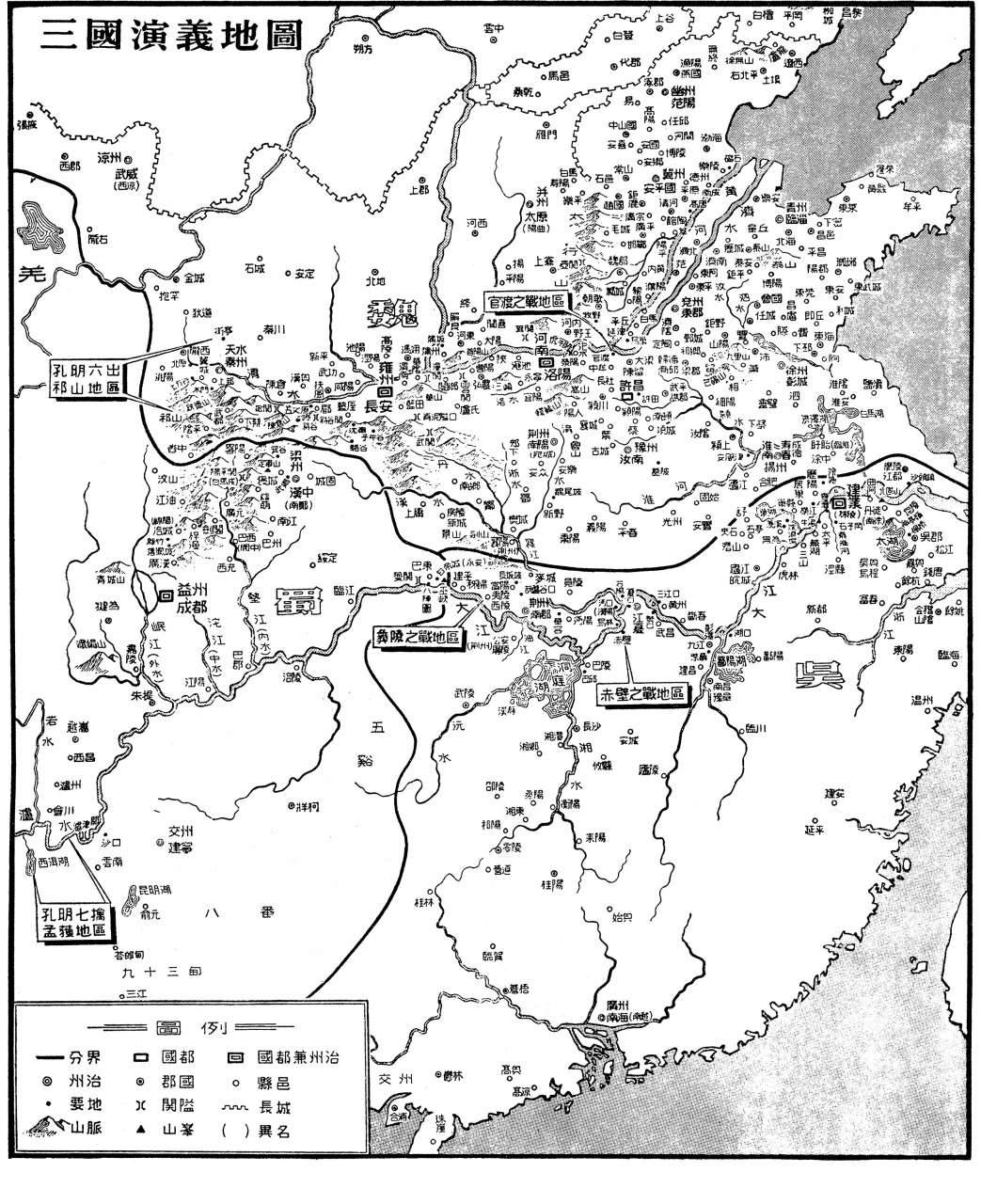
There are many plotlines in Three Kingdoms worth discussing, but given space constraints (or, honestly, I just don’t feel like writing more), I’ll focus on Red Cliffs.
The Battle of Red Cliffs is undoubtedly the crown jewel of the novel. All the great names make their entrance, stratagems fly thick and fast, and the intellectual duels between Zhou Yu and Kongming (Zhuge Liang) elevate the battle to the pinnacle of wit. I’ve always been fond of Zhou Yu — brimming with talent, dashing and heroic, brave and resourceful, commanding armies with brilliance, achieving greatness young (a winner in life), with the ability of a king’s right-hand minister. But to highlight Zhuge Liang’s genius, the novel deliberately places Zhou Yu’s talents a notch below Kongming at every turn, making him Red Cliffs’ absolute foil to set off Zhuge Liang. As I watched the TV series and read the novel, I increasingly felt that the early-period Zhuge Liang was simply a “monster” — “utterly inhuman.”
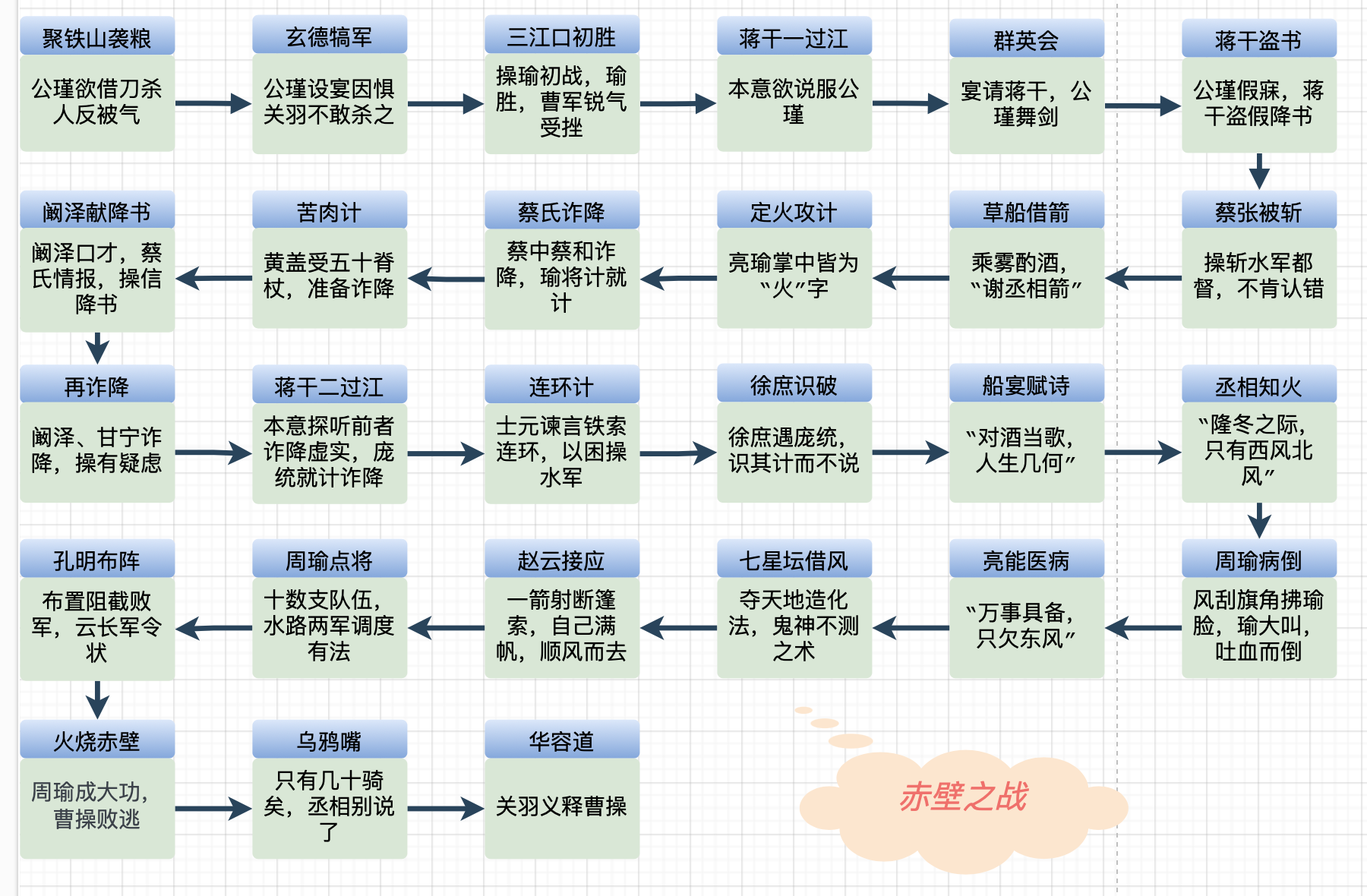
Red Cliffs features an all-star cast. All three of Liu Bei’s top strategists were involved: Zhuge Liang, Pang Tong (then serving Wu), and Xu Shu (then in Cao Cao’s camp) each played critical roles in the battle’s schemes. The warriors basically just cleaned up — only Liu Bei and Guan Yu visited Wu’s naval camp, and Zhao Yun once rescued the strategist. Wu itself was the protagonist, naturally — Zhou Yu, Lu Su, Huang Gai, Gan Ning, Kan Ze all had major parts, and the rest of the Wu officers were united in purpose, not a single one dragging their feet. On Cao Cao’s side: the Chancellor himself, advisers Cheng Yu and Xun You (Xun Yu and Jia Xu didn’t come; Guo Jia had died young), officers Mao Jie and Yu Jin, famous generals like Zhang Liao and Xu Chu essentially making cameo appearances, plus the tragic patsies Cai Mao, Zhang Yun, Cai Zhong, and Cai He, and the clown Jiang Gan… I suspect many people have never read Red Cliffs carefully, or perhaps never read the original at all. I specifically drew a flowchart:
Two favorite passages:
“A gust of wind blew, lifting a corner of the banner to brush across Zhou Yu’s face. Yu suddenly recalled something weighing on his heart, let out a great cry, fell backwards, and vomited blood.” This brief passage is gripping, vivid as a film scene, and underscores the importance of the southeast wind — not a single word wasted.
Yu said: “‘Man’s fate shifts between morning and evening’; how can one guarantee one’s safety?” Kongming smiled and replied: “‘The heavens hold storms none can foresee’; how can man predict them?” Yu turned pale upon hearing this and feigned moans of pain… Kongming smiled: “I have a prescription that will settle the Commander’s distress.” The entire exchange never once mentions the east wind, yet Yu and Liang have already dueled several rounds over it. Truly brilliant~
Embellishments#
Adding one’s own interpretations or plot elements on top of the original — I call these “embellishments.” The original plot is already extraordinarily compelling. Even where modern readers might find things hard to understand, if you immerse yourself in the mindset of ancient (Eastern Han!) people, there are virtually no logical gaps. This is one reason why Romance of the Three Kingdoms is held in such high regard. That’s why many people still prefer the old TV adaptation that respects the original (with minimal changes) over the new adaptation full of embellishments. Some embellishments — no one even knows who started them — conspiracy theorists abound, and many fabricated plotlines have become widely accepted as fact, which is truly a shame.
Kongming letting Cao Cao escape. At Huarong Trail, where Guan Yu spares Cao Cao out of a sense of honor, Kongming deliberately sent Guan Yu knowing Cao Cao would be released. This has spawned countless interpretations. But in the original, Cao Cao escapes simply because Kongming, observing the stars at night, concluded that Cao Cao was not fated to die that night. Don’t dismiss this as childish — the novel treats “star-reading” as a very real mystical phenomenon. “Read the stars and release Cao Cao” — this reason is entirely sufficient in the novel’s own terms. As for “they feared Wei’s retaliation so they let Cao Cao go” — pure later embellishment. Romance never once features a plot where someone refrains from killing out of fear of retaliation. The same goes for Guan Yu’s death.
Guan Yu’s death. In the original, both Wei and Wu wanted Guan Yu dead — such was the era, and in the novel, Guan Yu was a godlike figure. You couldn’t take Jing Province without killing him; both sides went all out. It’s true that later, when Liu Bei raised a great army for revenge, both Wu and Wei tried to pass the blame — but that’s all after Guan Yu’s death. Also, many later commentators believe Guan Yu should have defended Jing Province rather than attacking. Here I must clear General Guan’s name: attacking Fancheng was Zhuge Liang’s order. Guan Yu simply failed to take it.
Pang Tong’s death. The original says Kongming, observing the stars at night, saw a general’s star falling and sent a letter warning Liu Bei to be cautious. But Pang Shiyuan (Pang Tong) suspected Kongming was just afraid of him stealing glory and urging Liu Bei to advance slowly, so he in turn pressed Liu Bei to speed up the campaign — and ultimately died at Fallen Phoenix Slope. The new Three Kingdoms TV series embellished this: Liu Bei couldn’t bear to seize Yi Province, he knew there was an ambush but still entered Fallen Phoenix Slope, sacrificing himself to give Liu Bei a pretext to break with Liu Zhang… (this embellishment honestly disgusts me). Liu Bei and Liu Zhang’s conflict actually escalated gradually — Liu Zhang’s subordinates were already fighting Liu Bei, but the final break came when Liu Zhang discovered Zhang Song’s letter of surrender and realized Liu Bei’s wolfish treachery. While we’re here, let’s discuss a frequently debated detail: did Liu Bei give Pang Tong the Dílú horse? (The Dílú was said to bring misfortune to its rider; Xu Shu once advised Liu Bei to gift it to an enemy to avert the curse, then ride it himself — but immediately said he was merely testing Liu Bei’s character.) I’ve seen many comments assuming Liu Bei gave Pang Tong the Dílú, but reading the original carefully, it’s actually quite ambiguous. Liu Bei gave Pang Tong a white horse, but it’s never specified as the Dílú. In fact, after leaping across Tan Stream, the Dílú basically vanishes from the story. If it truly brought misfortune, Liu Bei had given it to Liu Biao (who returned it upon learning of the curse) — and Liu Biao died anyway. If it didn’t truly bring misfortune, that’s also plausible. Romance doesn’t treat all mystical elements as absolute truth: believing in them can be called respecting the spirits; disbelieving can be called being an extraordinary man or hero. Liu Bei and the Dílú lean more toward the latter, because Xu Shu was really just testing Liu Bei’s benevolence: “A man’s life and death are determined by fate — how could a horse be the cause?” If the horse truly brought misfortune, Xu Shu wouldn’t have said “I was testing you.” So personally, I believe what Liu Bei gave was not the Dílú, but simply one of his ordinary white horses. For a lord to gift his own horse was an immense honor in ancient times — this was simply meant to show Liu Bei’s genuine affection for Pang Tong. Later generations just preferred the Dílú storyline and embellished accordingly.
Diaochan’s righteousness. Only very rarely do embellishments improve things. In the original, the eighteen lords’ coalition was utterly helpless against the Western Liang army. After entering Luoyang, they all went their separate ways — while the Emperor remained in Dong Zhuo’s clutches… And then, contrast this with Diaochan, a mere woman: solely to repay Minister Wang Yun for raising her (Diaochan was his adopted daughter), she offered her body and successfully drove a wedge between Dong Zhuo and Lü Bu. After this, the novel mentions Diaochan very little (she simply follows Lü Bu, with no further plot involvement). The Three Kingdoms TV adaptation’s treatment of Diaochan after her success is truly brilliant. The old Three Kingdoms series adds an epilogue for her: to a hauntingly beautiful melody, Diaochan retreats into obscurity after her great deed, never to be heard from again. The fate of a nation rested on a frail woman — starkly contrasting with the warlords’ failure against Dong Zhuo and their secret scheming against each other. This segment is exquisite. Diaochan is a true hero! Compare this to the new Three Kingdoms’ treatment of Diaochan: pure schlock, fabricating a romance between Lü Bu and Diaochan — utterly an embellishment, disrespecting the original and even disrespecting Diaochan.
Mysticism#
It’s a novel, after all — many plot points are dramatized additions (the same goes for Water Margin and others). A bit of artistic license for reading pleasure is “the finishing touch on a dragon painting,” not “drawing legs on a snake.” Personally, I prefer to read Romance of the Three Kingdoms as a fantasy novel rather than a historical one.
The Yellow Turban Rebellion. The Yellow Turban Rebellion was less a peasant uprising than a religious war. At first, seeing Zhang Jiao cure people with talisman water, I assumed the author was portraying the Yellow Turbans as uncivilized charlatans. Then I discovered that Yu Ji also cured people with talisman water — and Yu Ji is clearly a positive character. Sun Ce disbelieved and ended up being mystically killed by the Little Conqueror. So talisman-water healing is a real thing in the author’s universe. The three Zhang brothers genuinely possess supernatural abilities, and the Yellow Turban army is basically a religious sect. I eventually accepted the talisman-water premise.
“His ears hung down to his shoulders, his hands reached past his knees, and his eyes could see his own ears.” Hands past the knees, fine — but eyes that can see your own ears? That’s not an eye problem, that’s an ear problem. The man was probably an elephant…
Killing one’s wife for food. While fleeing and seeking sustenance, Liu Bei encounters a hunter. Having found no game, the hunter kills his wife and serves her as food. Liu Bei only realizes the previous night’s meal was the man’s wife: “overcome with sorrow, he shed tears and mounted his horse.” When Cao Cao hears of the “kill-wife-for-food” incident, “Cao ordered Sun Qian to reward him with a hundred taels of gold.” Even someone like me, with fairly open views, was utterly shocked reading this. It’s astonishing how different ancient values were from ours, and lamentable how low women’s status was — mere objects…
Star-reading. In ancient times, star-reading was an official government post. In Romance, it’s a skill possessed by high-level strategists. Pang Tong lacks star-reading ability; Zhuge Liang and Sima Yi possess it.
Rǎng (禳). Actively attempting to alter fate. When Liu Bei’s Dílú horse threatened misfortune, the method Xu Shu described to dispel the calamity was called a rǎng ritual. Zhuge Liang used the qí-rǎng ritual to pray to the Northern Dipper, seeking to extend his life by one jì (twelve years).
Flaws#
Some important characters are described too sketchily. “By the time Song arrived, Zhang Jiao was already dead” — just a handful of words dismiss the death of the leader who ignited the earth-shaking Yellow Turban Rebellion. I always find this hard to accept; the author doesn’t even tell us how Zhang Jiao died. (If you Baidu it, you’ll just get middle-school history memorization paragraphs about why the Yellow Turban uprising failed…)
Some plotlines are repetitive. The famous “Borrowing Arrows with Straw Boats” actually appeared earlier. Sun Jian, while attacking Huang Zu, had a similar arrow-borrowing episode: “Jian plucked the arrows embedded in his boats, amounting to over a hundred thousand.” Red Cliffs and Yiling share similarities too — “southeast wind,” “boats loaded with thatch,” and “fire attack” are all keywords of Yiling as well. The Girdle Edict in the early chapters is a compelling storyline, and later there’s a parallel with Wei Emperor Cao Fang’s blood-written edict.
After Zhuge Liang’s death, the later plot isn’t very engaging. By then, almost everyone I knew was dead. There’s Jiang Wei and Deng Ai to follow, perhaps, but the plotlines are formulaic and dull. The new characters are numerous but lack distinctive portrayals — you basically can’t remember them. Later battle scenes all follow the same template: feign defeat, lure the enemy deep, a cannon blast, then charge.
Character Biographies#
A sharp-tongued review of several characters, with brief introductions, summaries, and key deeds. Though it doesn’t quite align with the novel’s spirit, people always love debating martial prowess and intelligence scores. Having read the entire novel, I’ll try to discuss the numbers here too.
For one-on-one combat ratings, it’s not about who defeated whom — Romance features many draws, or fights broken off after twenty or thirty bouts for various reasons. I measure by number of bouts exchanged. In Romance, 100 bouts is generally the upper limit; fighters may rest and resume for another 100, as with Ma Chao and Xu Chu.
Wei Side#
Cao Cao: Military strategist, statesman, man of letters. Extraordinarily fond of talent, shrewd himself, maxed out in both intelligence and ruling ability. The man who won the Central Plains battle royale. Welcoming Emperor Xian and establishing military farms (túntián) were both pivotal moves. There’s too much to say… Everyone knows “a crafty hero in turbulent times,” but few mention “an able minister in peaceful times.”
Xun Yu: Cao Cao’s key early strategist, intellect no less than Guo Jia. Loyal to the Han dynasty to the end. Killed by Cao Cao.
Xun You: Wei’s strategist in the humiliating Red Cliffs campaign. Has intelligence but a notch below Guo Jia and Xun Yu.
Guo Jia: Flawless. The number one grand-strategy adviser, relying on intellect rather than mysticism. Universally beloved. Died of illness while accompanying Cao Cao on the northern campaign. After Cao Cao’s defeat at Red Cliffs, he wept that Fengxiao (Guo Jia) was no longer with them — all others hung their heads in shame.
Cheng Yu: A strategist who appeared frequently in the early period. High intelligence — personally, I’d rate him roughly on par with Cao Cao: top-tier, but below Xun Yu and Guo Jia. At Red Cliffs, he saw through the southeast wind issue but was talked down by Cao Cao.
Jia Xu: Adviser to Li Jue, later joined Zhang Xiu, later surrendered to Cao Cao. An important mid-period Wei strategist.
Xu Chu: Wei’s top-tier solo combat god. Captured He Yi alive in one bout. Fought Ma Chao for 200 bouts — the bare-chested war god. During the Hanzhong campaign, drunk on grain-transport duty, he was slow to react and got stabbed in the shoulder by Zhang Fei. Limited appearances after that.
Dian Wei: Wei’s top-tier solo combat god. Master of twin halberds. Fought Xu Chu for two full shíchén (four hours). Felt like Cao Cao’s personal bodyguard. Killed during Zhang Xiu’s rebellion. Limited combat record.
Cao Ang: Cao Cao’s eldest son by Lady Liu. Killed during Zhang Xiu’s rebellion. Gave his horse to his father to ride, couldn’t escape himself. After the battle, Cao Cao wept only for Dian Wei, not for Cao Ang…
Cao Pi: Cao Cao’s eldest son by Lady Bian. One of the Three Caos. Proclaimed himself emperor immediately after Cao Cao’s death. Defeated at Hefei.
Cao Zhang: Cao Cao’s second son by Lady Bian. Has combat achievements — defeated Liu Feng in three bouts. A pure warrior archetype. “A real man should emulate great generals like Wei Qing and Huo Qubing, leading a hundred thousand troops across the desert, driving out the barbarians, building a legacy of achievement — who would want to be a scholar?”
Cao Zhi: Cao Cao’s third son by Lady Bian. One of the Three Caos. “Vain and flashy, lacking sincerity, addicted to wine and unrestrained.”
Cao Xiong: Cao Cao’s fourth son by Lady Bian. Killed in the power struggle when Cao Pi succeeded to the throne.
Cao Chong: Not mentioned in the novel.
Cao Ren: A commanding general, no solo combat record, but a master of city defense. (His troops) shot Zhou Yu at Nanjun; (his troops) shot Guan Yu at Fancheng. Died during Cao Pi’s reign.
Cao Hong: Often appears leading troops. Fought He Man for fifty bouts and killed him in single combat. Personally killed Yuan Tan. Rescued Cao Cao at a critical moment. Fought Ma Chao for fifty bouts — his blade technique grew disordered, his strength failing. With Cao Xiu, forced the Han Emperor to abdicate. No further appearances.
Xiahou Dun: Fierce and bold. Took an arrow to the eye and swallowed his own eyeball. Fought Gao Shun for fifty bouts — victory. During “Crossing Five Passes and Slaying Six Generals,” he challenged Guan Yu to a duel, interrupted by Zhang Liao. The Wei protagonist at Bowang Slope. Died of illness during Cao Pi’s reign.
Xiahou Yuan: Master of long-distance rapid strikes (couldn’t find the original quote). Many appearances leading troops — a general-type commander. Later killed by Huang Zhong at Mount Dingjun.
Zhang Liao: Leader of the Five Elite Generals. Formerly under Lü Bu; close friends with Guan Yu. First-rate at leading troops, decent at solo combat. While accompanying Cao Pi against Wu, shot in the waist and killed by Wu officer Ding Feng.
Zhang He: Of the Five Elite Generals. Framed by Guo Tu at Guandu; defected to Cao Cao. Defeated by Zhang Fei (at Zhang Fei’s tomb in Langzhong you can still see Zhang Fei’s inscription “Great Victory over Zhang He’s Forces”). Seems only able to trade a few dozen bouts with Zhang Fei — solo combat: average; commanding troops: first-rate. More appearances in the early period. Later, pursuing too deep, killed by Kongming’s massed crossbows at Jianmen Pass.
Xu Huang: Of the Five Elite Generals. Appears so often it’s impossible to recount everything. During Li Jue and Guo Si’s rebellion, served under Yang Feng, later defected to Cao Cao. Fought Xu Chu for fifty bouts — solo combat: decent. Also close friends with Guan Yu (during the Yan Liang-Wen Chou incident, Zhang Liao and Xu Huang fought poorly; Guan Yu stepped up and cut each down in one stroke — presumably this is when they became friends…). With Cao Ren, jointly defeated Guan Yu’s Jing Province army. Later, when Meng Da rebelled again, was shot in the forehead and died.
Yue Jin: Of the Five Elite Generals. Also appears very frequently, often leading troops. Fought Lü Bu’s officer Zang Ba for thirty bouts; fought Ling Tong for fifty bouts — solo combat: average. During the Hefei campaign against Sun Quan, while dueling Ling Tong, Cao Xiu shot Ling Tong off his horse; Gan Ning then shot Yue Jin in the face with a single arrow. Never appears again — unclear if he recovered.
Yu Jin: Of the Five Elite Generals. During Zhang Xiu’s rebellion, when people accused Yu Jin of defecting, he didn’t first clear his name but instead set up camp to resist the enemy — praised by Cao Cao. When Fancheng was besieged, he led reinforcements. Afraid Pang De would steal glory, he engaged in various petty maneuvers. Badly positioned his troops; Guan Yu flooded them and captured him. Yu Jin surrendered. After Lü Meng took Jing Province, he released the imprisoned Yu Jin back to Wei. Later scorned by Cao Pi; died in despondency.
Pang De: Previously under Ma Chao. Extraordinarily brave — a personal favorite. Carried his own coffin into battle. Could fight Guan Yu for 100 bouts — the highest honor in the solo-combat world. His reputation doesn’t match the Five Tiger Generals, Xu Chu, or Dian Wei, but I personally believe his solo combat ability is on the same level. Unfortunately, never truly utilized. Then dragged down by his deadweight teammate Yu Jin: Guan Yu flooded seven armies and captured him. Refused to submit to Guan Yu, refused to surrender, was executed. A true hero.
Li Dian: Frequently appears leading troops in the early-mid period. Captured Huang Shao alive. Solo combat: exchanged about ten bouts with Zhao Yun, realized he was outmatched, turned his horse and retreated. Never seen again after the Hefei campaign.
Lady Zhen: Yuan Xi’s wife. After Yuan Shao’s defeat, Cao Pi snatched her and made her empress.
Sima Yi: Late-period god-tier grand strategist. Can read stars. Can even grab a blade and solo. Fought Zhuge Liang to a standstill around Hanzhong. Never lost to Liang at the grand strategic level. Later seized Cao Shuang’s military power; the Sima clan took control of Wei.
Sima Shi: Sima Yi’s eldest son. His characterization in the late period is relatively well done. “Round face, large ears, square mouth, thick lips. Under his left eye grew a black mole, from which sprouted dozens of black hairs.” While battling Wen Yang, “his eyeball burst out from the mole’s wound, blood streaming across the ground. In unbearable agony, yet fearing it would unsettle the troops, he merely bit his quilt and endured — biting the quilt to shreds.” Then bedridden. Shortly after, “with a great cry, his eye burst forth, and he died.”
Sima Zhao: Sima Yi’s second son. Prince of Jin.
Sima Yan: Sima Zhao’s son. Emperor of Jin.
Deng Ai: Late-period undefeated war god. Fought Jiang Wei to a standstill, never lost at the grand strategic level. Rolled down a cliff wrapped in felt, launched a surprise raid into Shu — the Shu people thought divine soldiers had descended from heaven and opened their gates in surrender. The man who conquered Shu.
Shu Side#
Liu Bei: Everyone says Liu Bei’s benevolence was fake — personally, I think that’s an embellishment. From the novel’s portrayal of Xuande, Bei was genuinely benevolent. If he’d just taken Liu Biao’s resources in Jing Province directly, none of that mess would’ve happened. When entering Shu, the outcome was indeed duplicitous, but the novel still portrays Xuande with benevolence — I choose to respect the original here.
Guan Yu: A wildly popular character. Personally not a fan (in real life, this kind of person is extremely annoying). Early period: a god. Cut down foes in a single stroke. Single-handedly drove back Xu Huang + Xu Chu (probably only Lü Bu could match that feat). Arrogant and rude. Bears the lion’s share of blame for the loss of Jing Province. The loss of Jing is the novel’s plot turning point — Cao Cao, Liu Bei, Zhang Fei, Huang Zhong all die in rapid succession; remaining generals and strategists all fade from the storyline. Also, this man has an arrow-magnet constitution: shot during Crossing Five Passes, shot by an “air arrow” at Changsha fighting Huang Zhong, shot fighting Pang De, shot with a poisoned arrow attacking Fancheng.
Zhang Fei: Zhang Fei is a highly stylized character, but his combat record is better than Guan Yu’s. “Round-eyed rogue,” brave and cunning, hates evil like an enemy, true to his nature. The only person in the entire Three Kingdoms who dares to taunt Lü Bu. Can fight Lü Bu for 100 bouts. Drank off Cao Cao’s army at Changban Slope. Marched into Shu by land. Honorably released Yan Yan. Shattered Zhang He. Stabbed and wounded Xu Chu. Can lead troops, can solo, has tactical intelligence — a top-tier Three Kingdoms general. One scene is especially moving: after Guan Yu’s death, Liu Bei kept delaying the revenge campaign. Zhang Fei said to Liu Bei: “Our brother is dead — what’s the point of being emperor?” “If you won’t avenge our brother, don’t bother seeing me again.” 👍. I previously visited Zhang Fei’s tomb in Langzhong — his calligraphy was remarkably refined, nothing like the crude brute you’d imagine…
Zhuge Liang: A monster.
Pang Tong: “Sleeping Dragon and Young Phoenix — obtain one and you can have the realm” is pure bluster. Cannot be ranked alongside Zhuge Liang. Combat record is basically negative.
Xu Shu: God-tier grand strategist. Under Liu Bei (attached to Liu Biao), engineered the first-ever defeat of Cao Cao’s army (Cao Ren). Defining trait: filial piety… Cheng Yu forged a letter from his mother to summon Yuanzhi. Xu Shu went to Cao Cao’s camp; after his mother committed suicide, Xu Shu, out of pride, still wouldn’t return to Liu Bei’s side… utterly baffling.
Fa Zheng: The strategist for Huang Zhong’s army when Xiahou Yuan was killed. Other schemes had no weaknesses. Died early. One of only two people Zhuge Liang ever sought advice from.
Ma Su: The other person Zhuge Liang ever sought advice from. During the Southern Barbarian campaign, he was the first to propose a strategy aimed at winning hearts rather than annihilation. As long as he didn’t lead troops himself, god-tier. First time leading troops: defeated by Sima Yi. Later executed by the Chancellor. Also: the Chancellor shedding tears as he executed Ma Su — he wasn’t crying for Ma Su, but lamenting that the late Emperor’s legacy of the northern expedition remained unfulfilled.
Zhao Yun: Never lost a solo fight. No one could go 100 bouts with him. Basically, he’d show up and “spear them dead in one thrust.” Evasion maxed out — “the hero of Changban Slope is still in his prime.” Rarely led troops; more like Liu Bei’s personal guard, protecting the imperial family. Liu Bei called him brother, but he never entered the core trio.
Huang Zhong: Fought Guan Yu for 100 bouts at Changsha. His horse stumbled and Guan Yu spared him. Later shot an arrow without the arrowhead attached, repaying the debt. Killed Xiahou Yuan in the Hanzhong campaign.
Ma Chao: “Splendid Ma Chao.” Cao Cao: “Ma Chao’s valor is no less than Lü Bu’s in his prime.” Nearly made Cao Cao cut off his beard and discard his robe in flight — Cao was saved by Cao Hong. Fought top-tier warriors Xu Chu and Zhang Fei for 200 bouts each. Rash and cruel; committed city massacres. Limited achievements under Liu Bei.
Wei Yan: Had “a rebellious bone at the back of his skull.” An important Shu general in the mid-late period. Solo combat: decent. Leading troops: first-rate. Zhuge Liang predicted that after his death, Wei Yan would rebel — killed by Ma Dai. The famous Ziwu Valley gambit: though Sima Yi praised it, I personally think it’s a bit far-fetched.
Yan Yan: Solo combat ability basically zero. Pummeled by Zhang Fei. Archery ability: top-tier — shot Zhang Fei’s helmet. Participated in the Hanzhong campaign. No further appearances.
Huang Yueying: Actually, not much of a role. Only described when introducing Zhuge Liang’s son Zhuge Zhan: “The mother was exceedingly ugly but possessed extraordinary talents: versed in astronomy above, geography below; there was no book of strategy, divination, or escape arts she had not mastered.”
Zhuge Zhan: Son of the Marquis of Wu (Zhuge Liang). Hyped up upon debut, then sent against Deng Ai — killed by Deng Ai.
Liu Feng: Liu Bei’s adopted son. Solo combat ability: low. No tactical sense. Easily persuaded. A net negative. Guan Yu disliked him. Later, when Guan Yu was defeated and sought reinforcements, Liu Feng and Meng Da refused to send troops, contributing to Guan Yu’s death. Subsequently executed by Liu Bei.
Meng Da: Betrayed, then betrayed again. Shares blame for Guan Yu’s death. Only highlight: shot and killed Xu Huang. Later killed by Sima Yi.
Liu Bei’s Wives: Lady Gan — the one who threw herself into the well at Changban Slope, A-Dou’s birth mother. Lady Mi — died while Liu Bei was in Jing Province, which led to Wu’s marriage proposal. Sun Shangxiang — a fifty-something old ox marrying a sixteen-year-old girl…
Mi Zhu: Brother of Liu Bei’s wife Lady Mi. A tool character — basically Liu Bei’s envoy for delivering messages.
Mi Fang: Brother of Liu Bei’s wife Lady Mi. Technically the Emperor’s brother-in-law, yet surrendered to Wu. Bears responsibility for Guan Yu’s death.
Sun Qian, Jian Yong: Followed Liu Bei in the early period. No particular talent. Tool characters.
Guan Ping: Guan Yu’s adopted son. Fought Pang De for thirty bouts. Later captured alongside Guan Yu by Wu; executed.
Guan Xing: Guan Yu’s biological son. A key general in the mid-late period. Killed Pan Zhang — his father’s murderer — and recovered the Green Dragon Blade. A main combat general on the Qishan campaigns. Later died of illness.
Zhang Bao: Zhang Fei’s biological son. A key general in the mid-late period. Appears alongside Guan Xing.
Liao Hua: Originally a Yellow Turban, later followed Guan Yu. During the desperate escape from Mai Castle, ran out to seek reinforcements and survived. Later appears on the Qishan campaigns.
Zhou Cang: Originally under Zhang Bao, later followed Guan Yu — carried Guan Yu’s blade. Fought Zhao Yun and lost repeatedly, taking three spear wounds. Solo combat: weak. Committed suicide after Guan Yu’s death.
Ma Dai: A late-period Shu general. Frequent appearances. Achievements in the Southern Barbarian campaign and Qishan expeditions. Under the Chancellor’s brocade-bag stratagem, executed Wei Yan.
Jiang Wei: A Wei defector. Inherited Zhuge Liang’s will. Accomplished in both letters and arms. Launched (I think ten) expeditions from Qishan… Later, Deng Ai raided Shu; Liu Shan surrendered. Jiang Wei was still holding Jianmen Pass… “We fight to the death — why do you surrender first!”
Wu Side#
Sun Jian: Among the useless warlord coalition, capable of fighting. Obsessed with the Imperial Seal. Swore he didn’t have the Seal — “may I be shot dead by random arrows.” Later shot dead by Huang Zu’s troops.
Sun Ce: Sun Ce the Little Conqueror. A fierce warrior. Essentially conquered all of Jiangdong single-handedly — just died too young. A personal favorite. Trading the Imperial Seal for troops to build his kingdom — a stroke of genius, surpassing his father. Killed by an enemy’s revenge attack. While recovering, because he refused to believe in superstition, was mystically killed by Yu Ji.
Yu Ji: The people thought he was an immortal. Could cure people with talisman water. Executed by Sun Ce. His ghost haunted Sun Ce and killed him…
Sun Quan: Zero military talent whatsoever. Pummeled at Hefei. His strong point: recognizing talent. All four of Wu’s early (and most important) Grand Commanders were strong.
Taishi Ci: Appeared quite early — already present when Liu Bei was helping Tao Qian. Later joined Liu Yao, then was subdued by Sun Ce. Later, done in by Sun Quan at Hefei…
Gan Ning: “Brocade Sail Pirate.” Wu’s number one combat power. Expert archer. (Honestly, Wu’s generals’ combat ability is not impressive.)
Ling Tong: His father Ling Cao was killed by Gan Ning — a blood feud. During the Hefei campaign, saved by Gan Ning; they reconciled.
Huang Gai: Master of getting beaten. Actually, no combat highlights on the battlefield. At Red Cliffs, shot off his boat by Zhang Liao with one arrow, rescued by Zhou Yu. No further news.
Zhou Yu: Wu’s first Grand Commander. A winner in life. A personal favorite. Too bad: “Since Heaven gave birth to Yu, why did it also give birth to Liang?”
Zhang Hong: No role.
Zhang Zhao: Leader of the dove faction. Default answer to everything: surrender. Virtually none of his schemes ever worked.
Lu Su: Wu’s second Grand Commander. Timid. Appreciated by Zhou Yu. No combat achievements. Many say he was “shrewd beneath a foolish exterior” — the original does have hints of this, but “shrewd beneath foolish” is a stretch. Basically just a messenger between Liang and Yu. The originator of the empty-handed Jing Province recovery attempts.
Lü Meng: Wu’s third Grand Commander. Mastermind of “Crossing the River in White” (disguising troops as merchants). Can basically be considered the killer of Guan Yu. When he saw the beacon towers in Jing Province and couldn’t find a way to break through, he claimed illness and stayed home (absolutely hilarious). Later seen through by Lu Xun. After Guan Yu’s death, mystically killed by Guan Yu’s ghost.
Lu Xun: Wu’s fourth Grand Commander. Mastermind of Yiling. Later participated in several major campaigns. Lu Xun’s talent was not beneath Gongjin’s (Zhou Yu’s).
Zhou Tai: Fought his way in and out to rescue Sun Quan. For every wound he bore, Sun Quan made him drink a cup of wine.
Pan Zhang: Fought Guan Yu — lasted only three bouts before fleeing. Guan Yu’s spirit manifested; killed by Guan Xing.
Ding Feng: Shot and killed Zhang Liao. An important late-period Wu general. Survived until chapter 119.
Ma Zhong: Pan Zhang’s subordinate. Many have never heard of this character, but he killed both Guan Yu and Huang Zhong. Killing Guan Yu was cleaning up; killing Huang Zhong was genuine skill — one arrow took down the master archer Huang Zhong. Later assassinated by Mi Fang.
Jiang Qin, Han Dang, Xu Sheng…: Too many, unremarkable, can’t remember.
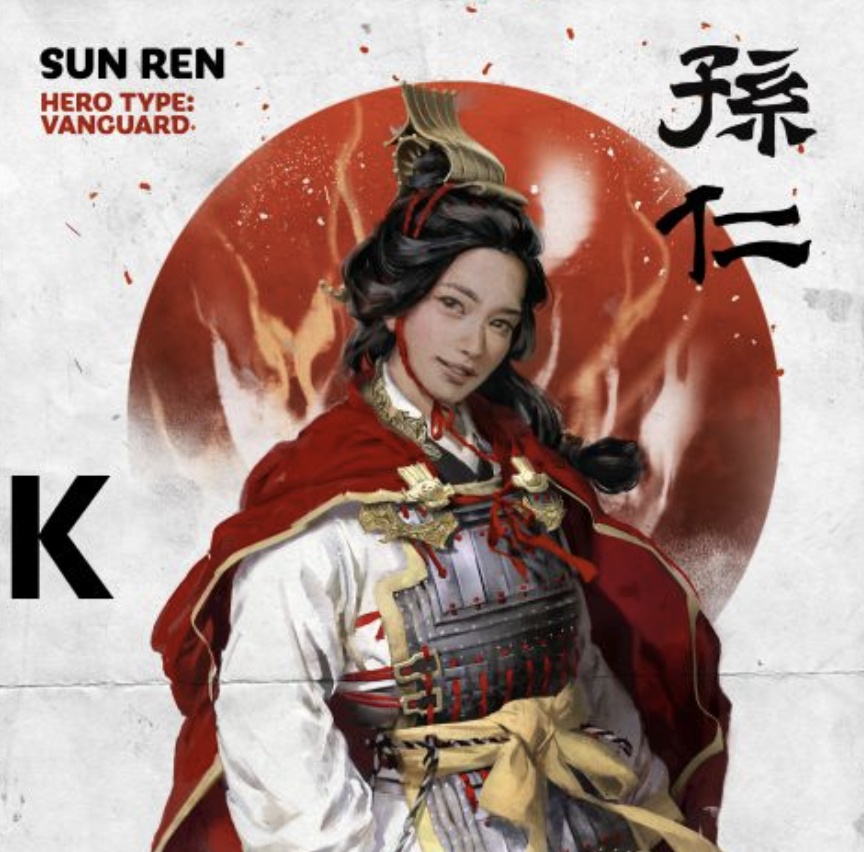
Sun Shangxiang: No such character exists in the official histories. In the novel, Sun Shangxiang has only personality description — she likes dancing with blades and swords. She never actually participated in combat. No children after marrying Liu Bei. Later tricked into returning to Wu; never saw Liu Bei again. But later generations adore Sun Shangxiang — she’s a fan-favorite character. Total War’s beauty icon:
Others#
He Jin: General-in-Chief, Empress He’s brother. An utter fool. Held all the cards and played them terribly. To deal with the Ten Regular Attendants, he summoned Dong Zhuo to the capital, setting off an unstoppable chain reaction — the realm fell into chaos.
Zhang Jiao, Zhang Bao, Zhang Liang: Yellow Turban rebel leaders. Could cure with talisman water, summoned divine soldiers. The rest of the time, basically got beaten up by the regular army. A religious peasant uprising, hastily concluded. The novel dismisses it with “Zhang Jiao was already dead.”
Yuan Shao: Previously under He Jin — back then he was quite strategic, even dared to confront Dong Zhuo directly. “Many schemes but poor decisions.” His advisers each pushed their own agenda; none of his generals were worth anything.
Yuan Tan, Yuan Xi, Yuan Shang: Yuan Shao’s three sons. Still fighting over power after Yuan Shao’s defeat.
Lü Bu: The number one warrior of the Three Kingdoms. Early period: unstoppable in single combat. Only lost when ganged up on. (Late period Lü Bu once soloed Zhang Fei.) Cao Cao had suffered at Lü Bu’s hands — ultimately Cao Cao was the big winner.
Chen Gong: After Cao Cao’s failed assassination of Dong Zhuo, Chen Gong followed him — and witnessed Cao Cao’s treachery: “Better that I betray the world than let the world betray me.” Disgusted with Cao Cao, he left and later joined Lü Bu.
Zhang Song: Liu Zhang’s subordinate. Arrogant. Cao Cao disliked him. Later defected to Liu Bei, offered the map of Western Sichuan. Later discovered by Liu Zhang colluding with Liu Bei; executed.
Zhang Xiu: Featured prominently in early battles against Cao Cao. Originally surrendered to Cao Cao, but because his aunt was forcibly taken by Cao Cao, he rebelled. Cao Ang and Dian Wei died in this battle. Later defeated by Cao Cao again; surrendered.
Chunyu Qiong: Commander of the Wuchao supply depot. Drinking ruined everything.
Li Ru: Dong Zhuo’s strategist. Never appears again after Dong Zhuo’s death.
Zuo Ci: A full chapter of pure mysticism. Stunned everyone reading it — “Come out and see the immortal~”
Yu Ji (the physician): Cao Cao’s doctor. Tried to poison Cao Cao; discovered.
Hua Tuo: The Three Kingdoms’ number one physician. Skilled in surgery. Treated Zhou Tai’s wounds. Scraped Guan Yu’s bones to cure poison. Later, while treating Cao Cao’s head ailment, suspected of being a second Yu Ji — died in prison.
Chen Lin: One of the Seven Masters of the Jian’an period. His “Proclamation Against the Usurper” is recommended reading in full.
Final Thoughts#
There’s simply too much to discuss. I thought I could finish this piece in two or three hours — ended up costing several times that. Romance of the Three Kingdoms is truly brilliant, absolutely worth reading (as if that needed saying). I probably won’t continue with the Records — time to urgently start the next chapter…