
Preface#
Homo Deus: A Brief History of Tomorrow is one of the trilogy by Israeli historian Yuval Noah Harari. The trilogy consists of Sapiens: A Brief History of Humankind, Homo Deus: A Brief History of Tomorrow, and 21 Lessons for the 21st Century. The most famous, of course, is Sapiens — an extraordinarily sweeping book about the history of human civilization that can absolutely reshape your view of history. Last year (2022), I persevered through the English original of Sapiens page by page — quite an achievement. Because I loved Sapiens so much, Homo Deus, the sequel from this giant of a thinker, naturally became this year’s most important “extracurricular reading.”
Sapiens tells the story of human history — from Homo sapiens standing upright to launching rockets to explore the stars: how did we get here? Homo Deus discusses the critical issues currently facing human civilization, and where we are headed.
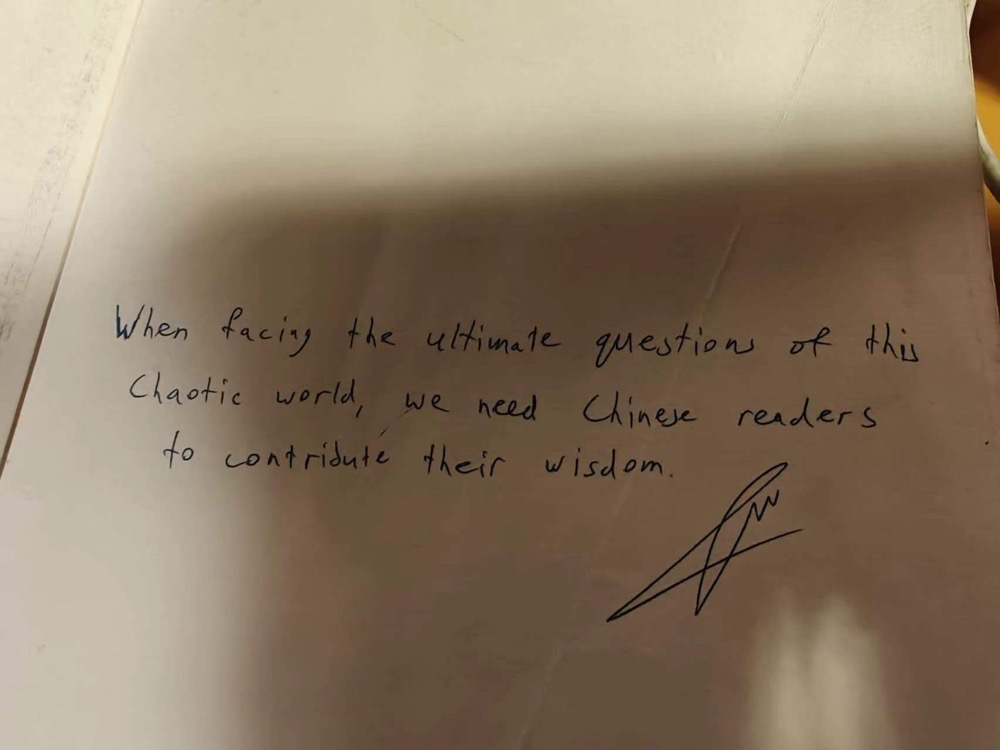
This copy of Homo Deus was hard to come by. In the end, I bought a second-hand Chinese edition from JD — it came from the library of Xingtan Liang Qiuju Middle School 😄. When I opened to the first page, a cheeky middle schooler had left a line of English. Let’s start with that:
When facing the ultimate questions of this chaotic world, we need Chinese readers to contribute their wisdom.
The New Agenda#
Famine#
Open almost any history book, and you’ll read about the horrors of famine and the insane behavior of people pushed to starvation. There’s no need to bring up famines in other countries — the most noteworthy case is right here in China. From the earliest written records all the way to the 20th century, China suffered the ravages of famine for thousands of years. We’ve always been an agricultural nation; nearly everyone had to work the land to feed themselves and their families. If crops failed — due to natural disasters (too much or too little rain, locust plagues, etc.) or human interference (bandits, oppressive taxes, irregular planting) — some people would face food shortages. Most modern people have no idea what it feels like to go without food for days on end. I’ve been hungry for stretches myself, and I know that prolonged hunger is a misery the average person can’t imagine — but even I was never at risk of starving to death. Yet our ancestors, facing the prospect of actually starving to death, what kind of despair must they have felt? They had no solution but to pray to the gods for favorable weather and a bountiful harvest the following year.
There’s a line from House of Cards that really stuck with me: “Twenty years ago, I couldn’t buy sugar in China. Now I can buy it anywhere.” Crude as it sounds, it reflects a reality: the Chinese people have escaped poverty. For the first time in Chinese history, we are no longer tormented by famine. We created this economic miracle — something worth recording! Similarly, human civilization as a whole has recently solved the problem of hunger. Food shortages in particular regions are almost always caused by political factors, and internationally, there are ample surplus resources for emergency response to shortages. Food scarcity is no longer a human agenda item.
On the contrary, humanity is no longer concerned with food shortages but is starting to worry about food surpluses. Health problems caused by obesity and malnutrition far outnumber those caused by starvation. Many people mindlessly chew through bread, rice, and loads of carbohydrates without getting enough protein and vitamins. The rich eat lettuce salads; poor Westerners eat cake, burgers, and pizza; and I eat fried dough sticks, steamed buns, rice, and noodles — my weight keeps climbing every day, and my health problems multiply year by year…
Bacteria and Viruses#
- The Black Death: In the 1330s, the Black Death — the bacterium Yersinia pestis — caused 70 to 200 million deaths worldwide, with a mortality rate of roughly 50%.
- The Spanish Flu: 1918. Infected 500 million people; 50 to 100 million died. Mortality rate around 15%.
- Smallpox: 1967 — 15 million infected, 2 million deaths. Mortality rate about 15%. Following global smallpox vaccination, the smallpox virus was eradicated by humanity in 1979.
- AIDS: Broke out in the 1980s. Over 30 million deaths. Destroys the immune system. Current medications are effective but cannot provide a perfect cure. Infection rate: 0.9%. Mortality rate: 1.28 per 100,000.
- SARS: 2003. 8,000 infected, over 700 deaths.
- Avian Flu: Fewer than 1,000 deaths.
- H1N1 Swine Flu: 2009. 700 million to 1.4 billion infected. Approximately 150,000 to 600,000 deaths. Infection rate: 20%. Mortality rate: ~0.02%.
- Ebola: Multiple outbreaks in Africa. Mortality rate above 50%.
Of the above, only the Black Death is bacterial; all the rest are viral. The Black Death is too ancient; though bacterial, due to the primitive state of medical care at the time, people had no idea what was happening, leading to massive casualties and an extraordinarily high fatality rate. Smallpox is humanity’s greatest success story in the war against viruses — through modern medicine and vaccines, we outright eliminated the smallpox virus. As you can see, humanity has developed a silver bullet for bacteria — antibiotics. Bacterial epidemics are essentially gone. But for viral influenzas, they keep emerging in an endless cycle: as one subsides, another rises. There’s no great solution; modern medicine still has room to improve against viral epidemics. Major viral pandemics still strike every few years, and seasonal flu never stops accompanying us.
Most of these influenzas are weathered by the human immune system alone — modern medicine only plays a supporting role (basically, bringing down fevers). Especially for human infants: aside from getting all manner of vaccines right after birth, every other “cold” has to be tough out by their own immune systems, with very few effective medications available. Kindergarten is less a place of learning and more a trial ground for human influenza and immune resistance.
- COVID-19: Homo Deus was published in 2015, before COVID-19 happened. The author’s view on epidemics was: “Doctors can quickly get up to speed and rapidly discover treatments — humanity has probably already conquered epidemics.” I wonder what Yuval Noah Harari makes of COVID-19.
Regarding COVID-19, there’s simply too much I want to say. Too many grievances to express coherently. In a single sentence: “On the matter of COVID-19, humanity was utterly shattered and exposed in all its ugliness.”
War#
Skipped.
Humanism#
The concept of humanism emerged during the Renaissance, championing human rights and individual value in opposition to the religious theocracy of the time. It reached China roughly in the late Qing dynasty. Humanism has had a profound impact on modern society: people increasingly emphasize the concepts of the individual or the collective, rather than top-down religious dogma and the divine right of kings.
Humanism advocates human rights against divine right, and individual freedom against personal dependency. What humanism worships is human nature — the human being itself.
People are always contemplating the meaning of life. Humanism holds that humanity itself is the source of meaning: “I am the meaning.” It also holds that free will is the highest authority. Humanism proposes a new life principle: “If I feel it’s good, it’s good; if I feel it’s bad, it’s bad.” For example: if a woman has an affair, in pre-humanist society, she would face punishment from religion and social norms — the censure of priests and elders. In modern society, she need only heed her own true feelings; the best approach is to follow her own inner voice.
For society as a whole: what everyone believes is good is “good”; what everyone believes is bad is “bad.” Take theft, for example. For the victim, it’s certainly bad. For everyone else, it’s also bad — because others don’t want to be stolen from either, including thieves themselves. Thus, theft is bad, and people can even write it into a mutually binding document. By the same logic, if a certain behavior feels bad to no one at all, then it’s not wrong. This naturally leads to the question of homosexuality: two people of the same sex feel that this is good, and it affects no one else — therefore, it’s not wrong. So humanism supports homosexuality and opposes religion.
Humanism can perfectly address these two types of extreme questions. But for events that are good for some and bad for others — like the trolley problem — it’s much harder to answer. In ancient societies, Confucianism advocated that women remain faithful to one husband unto death, even erecting chastity archways. In modern society, as long as one can find happy days, people don’t want to stay bound in misery. But what if divorce leads to happiness for one side and utter misery for the other? Add the emotional harm to the children, and the whole situation becomes very hard to measure: whose happiness matters more? Humanism will only tell you: “Follow your own heart."~
As humanism gained broader acceptance, it evolved into three major branches:
Liberal Humanism: The “orthodox” liberal humanism, also known as liberalism. The individual enjoys freedom; individual choice is respected. If it feels right to each person, it’s right. The classic example is liberalism’s belief that the ballot box represents individual will. But this requires one precondition: before voting, everyone must be “one of us.” For instance, the American North and South in 1861, or Israel and Palestine today — neither could possibly resolve their issues by having everyone vote together.
Socialist Humanism: Socialist humanism doesn’t focus on individual feelings, viewing them as a bourgeois trap. What “I” feel in the present moment is merely a reflection of my environment, determined by my class. Liberalism believes voters can make the best choice; socialist humanism believes the organization can make the best choice. The individual must obey the organization’s decisions, not personal feelings.
Evolutionary Humanism: Evolutionary humanism derives from Darwin’s theory of evolution. It holds that conflict is a form of evolution — eliminating the weak, survival of the fittest. Superior people deserve to survive; this is the law of human evolution. Evolutionary humanism was once all the rage, giving rise to many ideas such as eugenics, racism, and fascism.
From 1914 to 1989, the three humanisms waged a war of faith. Liberalism and socialism joined forces to defeat Nazism in World War II. Then liberal nations and the Soviet Union each rallied allies into the Cold War. In the early Cold War, socialism consistently held the upper hand (the documentary The Vietnam War is highly recommended here) — students at UC Berkeley even kept Chairman Mao’s Little Red Book by their bedsides. Then, everything changed. The Soviet Union collapsed. Many countries shifted their beliefs; we too introduced market capitalism. People preferred supermarkets (or Taobao) and money-making companies over a system that allocated food and clothing. Liberalism won a sweeping victory in this war of faith — they even evolved further, adopting ideas and institutions from their rivals to provide better education, healthcare, and social security than before. But liberalism’s core ideology remained unchanged.
Dataism#
Dataism holds the following three views:
- Organisms are algorithms.
- Intelligence can exist without consciousness.
- Highly intelligent algorithms know me better than I know myself.
Organisms Are Algorithms#
“Organisms are algorithms” — I couldn’t accept this notion when I first encountered it either. How could organisms be algorithms? Doesn’t human experience matter? Is human consciousness worthless?
Looking at capitalism and Soviet-style communism from the perspective of data processing, they are no longer ideological opposites but rather different data algorithms. Capitalism employs a distributed algorithm; Soviet-style communism employs a centralized algorithm. Capitalism allows connections between consumers and producers, permits individuals to freely exchange information and make independent decisions — the pricing and output of goods are determined by the free market. Soviet-style communism, on the other hand, severed the link between producers and consumers: the government collected consumption data and issued production directives to producers. The government took all of the workers’ productive surplus, then determined what each individual needed, then re-distributed accordingly. Tax rates work the same way — high tax rates essentially concentrate more resources together, with the government as a single processor deciding how resources are allocated and utilized.
A single processor can’t possibly make the right decisions forever. No one person can handle such enormous amounts of data — even today’s high-speed computers can’t process it all.
From the perspective of Dataism, capitalism won the Cold War because its distributed algorithm was better suited to that era than Soviet-style communism’s centralized algorithm: the better data algorithm prevailed. When we chose to embrace the market economy and abandon Soviet-style communism, it was equivalent to decentralizing processing power to every individual, no longer using the single-processor model. That’s why Socialism with Chinese Characteristics survived the Cold War, while the Soviet single-processor data model failed utterly. Currently, only a very few authoritarian states still use this single-processor model — and after all these years, we’ve seen no productivity advances from them. This is also a real-world reflection of “organisms are algorithms.”
I’m merely using the Dataist lens to view economic models here — no intention of judging which model is better or worse. Beyond fitting economic models so neatly, Dataism can also be applied to view problems in many other domains.
Intelligence Can Exist Without Consciousness#
First, we need to be clear: what is consciousness? Someone might say, “Consciousness is the self,” or “Consciousness is the voice inside.” These don’t answer the question scientifically. Note: science deals with objective facts; subjective matters fall outside science’s domain — they belong to theology. We cannot explain the subjective using the subjective. In truth, humanity still hasn’t figured out what consciousness is.
If every person is an algorithm, then there’s really no concept of “autonomous consciousness.” We can regard what we hear, smell, and see as “input data.” After computation by our biological organism, a response is produced and an action taken — that’s the “output data.” The human body itself is more like a CPU — perhaps one that can self-regulate, but even the regulation itself requires data input, like learning knowledge or exercising. So what role does “self-consciousness” play in this process? I can clearly make choices about something — if I choose differently, a different outcome results. I must be consciously aware… right? This question may not be so easy to answer. If, hypothetically, there were no subjective consciousness — not brain death, but “I can’t feel my self” — would “I” still make different choices?
From a biological perspective, consciousness is nothing more than countless electrical currents in the brain’s neural network. When “I” make a different choice, it may simply be that some nerve ending fired an extra tiny electrical pulse. “Self-consciousness” played no role whatsoever in this process. Without “me,” it seems my body could still make different choices, as long as the “algorithm” stored in my body still exists. If “self-consciousness” exists, it’s more like a belief rather than an objective fact — like believing in God. The most cutting-edge biological science suggests that consciousness is merely a byproduct of an individual organism’s algorithms — it could even be viewed as a kind of mental pollution.
Then we arrive at another question: is artificial intelligence (AI) conscious? If it’s not conscious, can we treat it as an intelligent being? The best method humans currently have for testing whether AI has consciousness is the Turing Test. The Turing Test’s logic is simple: as long as a normal human can’t tell whether the AI is human or not, it passes. In other words, once AI becomes smart enough, we humans have no choice but to consider it “conscious.”
Algorithms Know Me Better Than I Know Myself#
Humanism calls on us to listen to our inner authentic voice. But if the self doesn’t even exist, what is there to listen to? Dataism calls on us to “listen to the algorithm’s advice” — the algorithm knows me better than I know myself. For example: when a woman is on a blind date and meets two men who both seem suitable, without algorithmic assistance, she would follow her inner voice and choose the one who “feels” more right. Now imagine an algorithm tells her: “I know you very well. I know you’re attracted to Man A; you’ll choose him. But he will ultimately break your heart and leave you. Man B is the one for you — and if you choose B, you’ll fall in love just as quickly. He will give you lasting happiness. This is a choice you won’t regret.” From any angle, shouldn’t she listen to the algorithm’s advice rather than that fleeting feeling of the moment?
In its early R&D phase, algorithms are built by engineers continuously piling up code. At this stage, people still have a decent grasp of what the algorithm is “thinking.” But algorithms can self-learn and self-update. Their learning capacity is utterly beyond human comparison. They will gradually carve out their own path, until humans can no longer keep up.
Closing Thoughts#
Homo Deus is, as ever, packed with substance — novel, robust ideas, all-encompassing. A highly recommended work. While reading, I often paused to reflect: does what he’s saying match reality? Is it correct? Many times, I felt shocked. I used to never underline when reading books, but I did so with this one. When I finished, I found the book covered in my highlights.
This monumental work is so dense with content that this article can’t possibly cover everything. This piece is relatively one-sided — I’ve mostly only discussed productivity-related viewpoints. There’s actually a great deal of other fascinating material, such as the book’s perspective on “happiness”: “Would you rather be an unhappy but wealthy Singaporean, or a happy but poor Costa Rican?” I don’t know how I’d answer. But if the author rephrased the question to me as: “Would you rather eat more hot pot, or eat vegetables and whole grains every day, maintaining a nutritionally balanced, healthy body?” — then I’d definitely answer: hot pot.