
Preface#
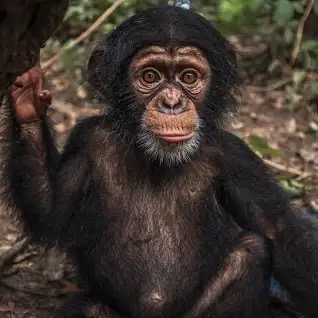
Frans de Waal’s seminal work Chimpanzee Politics was published in 1982 — his first book and also recommended reading for incoming members of the U.S. Congress. Another work of his I read previously, Are We Smart Enough to Know How Smart Animals Are?, was from 2016 — such a vast timespan between them. Are We Smart Enough introduced many animal behaviors, including those of humanity’s numerous close relatives, while Chimpanzee Politics focuses solely on our very closest relative — the chimpanzee. It observes a chimpanzee colony in a zoo and analyzes the structure, evolution, and behaviors of chimpanzee social power and politics.
If you see chimpanzees at the zoo mating brazenly in broad daylight without any inhibitions, or screaming and attacking one another — seemingly devoid of moral restraint, showing no trace of civilization — then the English title of Are We Smart Enough serves as a perfect retort: “Are We Smart Enough to Know How Smart Animals Are?”
Power and Alliances#
It’s commonly assumed that in animal social structures, the strongest male becomes the leader. This does broadly align with chimpanzee social structure. But it’s far from that simple — physical strength is not the sole factor determining dominance relationships. Alliances are the crucial factor, perhaps the most important factor. The book spends extensive passages discussing “triangular relationships.” Here, I need to introduce the book’s three main chimpanzee protagonists:
Yeroen (the elder) — Luit (the middle) — Nikkie (the young)
These three male chimpanzees form a power center — the power core of this chimpanzee colony — and their political struggles play out on this political stage. All three have, at different times, been the colony’s alpha. Initially, the capable and broadly respected Yeroen was alpha. Then Luit took over. Finally, Nikkie established a puppet-style rule. They built a hierarchical organization and competed within it for dominance over the rest of the group.
First: a male with superior fighting ability cannot simply usurp the group’s leadership. Power collapses not when a challenger defeats the current ruler in combat, but when the ruler can no longer protect other members of the society. During Luit’s bid for power, Luit and his ally Nikkie constantly attacked other group members, and when the Luit-Nikkie alliance was present together, Yeroen could not offer protection to others.
The Luit-Nikkie alliance played a decisive role in toppling the Yeroen dynasty. But Yeroen’s fall from power also created new alliance opportunities — just like human politicians, chimpanzees seize such opportunities too. Yeroen found the key player in the current “triangular relationship”: Nikkie.
Before Yeroen’s fall, Nikkie was Luit’s ally. Afterward, Nikkie became Yeroen’s ally. Why would the seasoned Yeroen support Nikkie after losing power?
- For Nikkie: he went from number two to number one. He was the “person” most eager for Yeroen’s support.
- For Yeroen: an alliance with Nikkie secured his position as number two in the group, and Nikkie — relative to Yeroen — needed his support more. Nikkie couldn’t openly oppose Yeroen, because if he did, Nikkie’s own position would become unstable. Yeroen gained more freedom of action and traded it for more mating opportunities with females.
- As for Luit: he dropped from the top of the power rankings to number three.
The Yeroen-Nikkie alliance, though tight, featured a very cunning Yeroen. Although Yeroen’s relationship with Luit was terrible, Yeroen would still proactively approach Luit — and Nikkie would invariably intervene, without exception. Why did Yeroen seek contact with Luit? Yeroen approached Luit precisely to put on a show for Nikkie. For Nikkie, Yeroen’s behavior served as a constant reminder that Nikkie’s position depended entirely on Yeroen’s choices. The young Nikkie lacked strong grassroots support from the group. The seasoned, cunning Yeroen held Nikkie in the palm of his hand — Nikkie’s ruling foundation did not rest under his own feet.
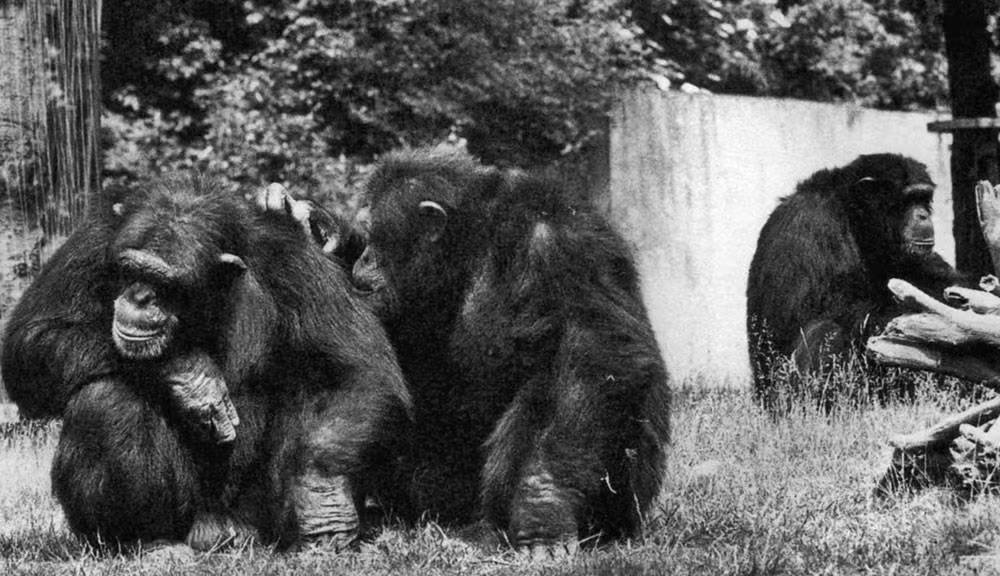
When one chimpanzee grooms another’s fur, this is not merely a simple biological act — it’s a reflection of the two chimpanzees’ social relationship, signifying that their bond is sufficiently strong, or that one seeks a favor from the other. A classic scenario in the triangular relationship: Nikkie (center) grooms his ally Yeroen (left), while Luit (right) sits alone at a short distance.
Males and Females in Power#
Although males are generally stronger than females, male chimpanzees do not use their full strength when attacking females. Males only bite and tear at each other when facing another male.
Social mammal groups are typically composed of many females and a few males. Females also play an important role in power struggles.
Female chimpanzees tend to avoid competition because they need a safer, more stable environment to raise offspring. Power transitions in the group do not happen instantaneously — when Luit replaced Yeroen, the process took over two months. During those two months, the two chimpanzees repeatedly fought and reconciled. Female chimpanzees played a vital mediating role in this process. Females would proactively embrace both of them, breaking the tension during confrontations and working hard to push them toward reconciliation.
Male leadership arises from strength, alliances, and support levels. Females also have a leader, but female leadership is determined by character and age. Females almost never need to fight each other; the probability of conflict between females is extremely low, and their hierarchical order can persist for many years.
Social psychologists, through alliance-game testing, have found that males take more proactive action, while females place more emphasis on the atmosphere of the game. In competitive activities, men are all about achieving strategic objectives — they prefer to seize the “big” events. Women are more interested in individual connections, forming alliances with those they like, and they focus on the immediate rather than distant political goals. Of course, these are statistical tendencies — exceptions always exist.
Power and Sex#
Avoiding incest is a moral or legal constraint in human society, often considered part of human culture. If mating were purposeless, would group-living chimpanzees have incest problems? In reality, such problems are extremely rare. Chimpanzees actively avoid incest. Mothers know who their sons are, and when a son reaches adulthood, chimpanzee mothers absolutely will not tolerate incestuous behavior. Young chimpanzees may not know who their fathers are, but they strongly resist mating with males roughly their father’s age. Biologists believe incest avoidance is a natural law deeply embedded in culture.
Power and sex are certainly linked. Chimpanzee alphas typically enjoy extremely high mating privileges — until overthrown by a rebel. But these mating privileges occur during ordinary times; female chimpanzees will secretly mate with males they treated coldly during the day — at night, or in places the alpha can’t see, like in the tall grass. How similar this is to human society needs no elaboration.
Jealousy produces more offspring. Chimpanzee social structure includes multiple females and males. More jealous males will do everything to prevent other males from contacting females, giving themselves more opportunities to sire offspring — and those offspring, in turn, will also be more jealous. Females, however, are entirely different: no matter whom she mates with, her number of offspring is fixed, and the offspring are always hers. So jealousy among females is not pronounced. But in pair-bonding species, things look completely different — in pair-bonding species, females also engage in sexual competition. In such cases, females are more inclined to maintain long-term relationships with males. In modern human society, men care more about whether their female partner has had sex with another man; women care more about whether their partner has fallen in love with another woman. At its essence, even the cornerstone of human society — the family — is merely a unit of sex and reproduction.
Closing#
There’s actually a lot more interesting material I haven’t gotten to — too lazy to expand further. Some perspectives I personally really like:
- “Humans are engaged in continuous office competition while simultaneously uniting against a common enemy.”
- “Hierarchical order is a cohesive factor that imposes limits on competition and conflict.”
- “The roots of politics are far older than humanity.”
Universal Safety Disclaimer#
Large portions of this article are drawn from the book Chimpanzee Politics and do not represent my personal views.