
命令选项#
TRUNCATE [ TABLE ] [ ONLY ] name [ * ] [, ... ]
[ RESTART IDENTITY | CONTINUE IDENTITY ] [ CASCADE | RESTRICT ]1.ONLY:只truncate指定的表。当表有继承子表或有子分区时,默认会一起truncate;only可只truncate继承父表。分区父表不能指定only
--不能truncate only分区父表
=> truncate only parttable;
ERROR:  42809: cannot truncate only a partitioned table
HINT:  Do not specify the ONLY keyword, or use TRUNCATE ONLY on the partitions directly.
LOCATION:  ExecuteTruncate, tablecmds.c:1655
--truncate only继承父表,只清理父表
=> truncate table only parenttable;
TRUNCATE TABLE
=> select tableoid::regclass,count(*) from parenttable group by tableoid::regclass ;
tableoid | count
------------+-------
childtable | 1
--直接truncate继承父表,子表也会被清理
=> truncate table parenttable;
TRUNCATE TABLE
=> select tableoid::regclass,count(*) from parenttable group by tableoid::regclass ;
tableoid | count
----------+-------
(0 rows)2.RESTART IDENTITY CONTINUE IDENTITY:列上的序列是否要重置,默认CONTINUE。
--bigserial 默认会创建列上的序列
=> create table tableserial (a  bigserial not null,b name);
CREATE TABLE
=> \d+ tableserial;
                                               Table "public.tableserial"
 Column |  Type  | Collation | Nullable |                Default                 | Storage | Stats target | Description
--------+--------+-----------+----------+----------------------------------------+---------+--------------+-------------
 a      | bigint |           | not null | nextval('tableserial_a_seq'::regclass) | plain   |              |
 b      | name   |           |          |                                        | plain   |              |

=> insert into tableserial(b) select md5(random()::text) from generate_series(1,1000);
INSERT 0 1000
--seq当前值为1000
=> select currval('tableserial_a_seq'::regclass);
 currval
---------
    1000

--直接truncate默认不会重置序列
=>  truncate table tableserial;
TRUNCATE TABLE
=> select currval('tableserial_a_seq'::regclass) cur,nextval('tableserial_a_seq'::regclass);
 cur  | nextval
------+---------
 1000 |    1001

--显示指定RESTART IDENTITY,重置序列
=>  truncate table tableserial RESTART IDENTITY;
TRUNCATE TABLE
--注意seq在nextval时重置了
=>  select currval('tableserial_a_seq'::regclass) cur,nextval('tableserial_a_seq'::regclass);
 cur  | nextval
------+---------
1001 | 13.CASCADE:清理表及其所有外键表的数据
--创建主表和外键表和数据
=>  create table pri_tab(id bigint primary key,name varchar(10));
CREATE TABLE

=> insert into pri_tab values (1,'abc'),(2,'abc'),(3,'abc');
INSERT 0 3

=>  create table frn_tab(id bigint,FOREIGN KEY (id) REFERENCES pri_tab(id));
CREATE TABLE

=> insert into frn_tab values (1),(2);
INSERT 0 2

=> select * from pri_tab;
 id | name
----+------
  1 | abc
  2 | abc
  3 | abc
(3 rows)

--外键表frn_tab依赖主表pri_tab的数据
=> select * from frn_tab;
 id
----
  1
  2
(2 rows)

--有主表外键reference时,外键表必须跟cascade,否则无法清理
=> truncate table pri_tab ;
ERROR:  0A000: cannot truncate a table referenced in a foreign key constraint
DETAIL:  Table "frn_tab" references "pri_tab".
HINT:  Truncate table "frn_tab" at the same time, or use TRUNCATE ... CASCADE.
LOCATION:  heap_truncate_check_FKs, heap.c:3427

--外键约束的表一起清空
=> truncate table pri_tab cascade;
NOTICE:  00000: truncate cascades to table "frn_tab"
LOCATION:  ExecuteTruncateGuts, tablecmds.c:1725
TRUNCATE TABLE
=> select * from pri_tab;
 id | name
----+------
(0 rows)

=>  select * from frn_tab;
 id
----
(0 rows)
由于外键表依赖主表的数据,不能直接truncate主表,必须加cascade,此时外键表也跟随主表一起清空
4.RESTRICT
是否清理foreign key表。没什么用,default选项,加不加都是这样。清理附带的外键表应加CASCADE。
MVCC/transaction#
pg官方文档有这么一段化
TRUNCATEis not MVCC-safe. After truncation, the table will appear empty to concurrent transactions, if they are using a snapshot taken before the truncation occurred.TRUNCATEis transaction-safe with respect to the data in the tables: the truncation will be safely rolled back if the surrounding transaction does not commit.
transaction-safe意思是可以放在事务块里,可以回退 回滚truncate:
=> begin;
BEGIN
=> truncate t1;
TRUNCATE TABLE
=> rollback;
ROLLBACK
=> select count(*) from t1;
 count
-------
   100
not MVCC-safe意思是一个会话在truncate前打了一个快照,快照期间如果发生truncate,这个快照是可以读到truncate清理后的结果的。这不符合MVCC。 不过这个问题不算太大,在会话场景下,因为truncate是8级锁,快照没有结束的话最低在表上有一个读共享锁,所以truncate不会执行。
This will only be an issue for a transaction that did not access the table in question before the DDL command started —any transaction that has done so would hold at least an
ACCESS SHAREtable lock, which would block the DDL command until that transaction completes
功能更新#
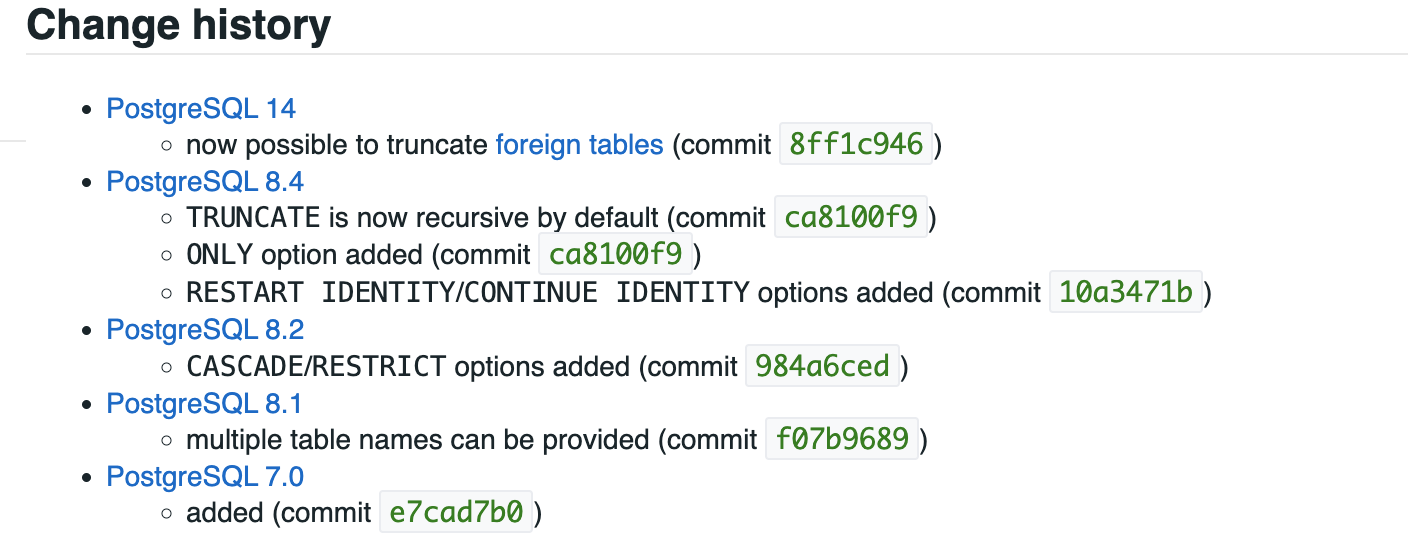 truncate更新功能不多,只需要注意14的时候支持truncate foreign tables即可。truncate foreign tables前提是fdw得支持TRUNCATE API
Also it extends postgres_fdw so that it can issue TRUNCATE command to foreign servers, by adding new routine for that TRUNCATE API.
pg truncate和其他库的功能差异#
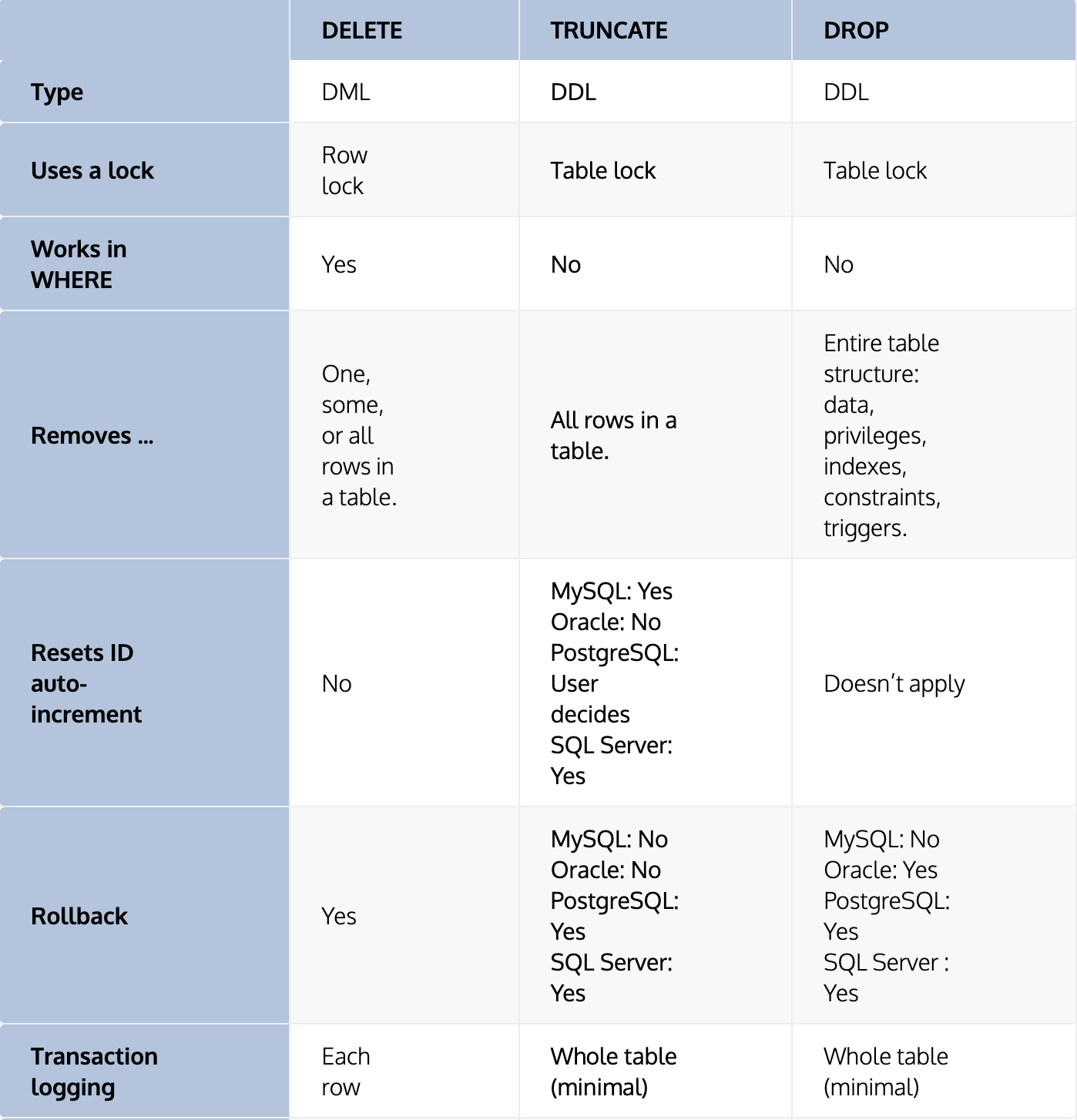
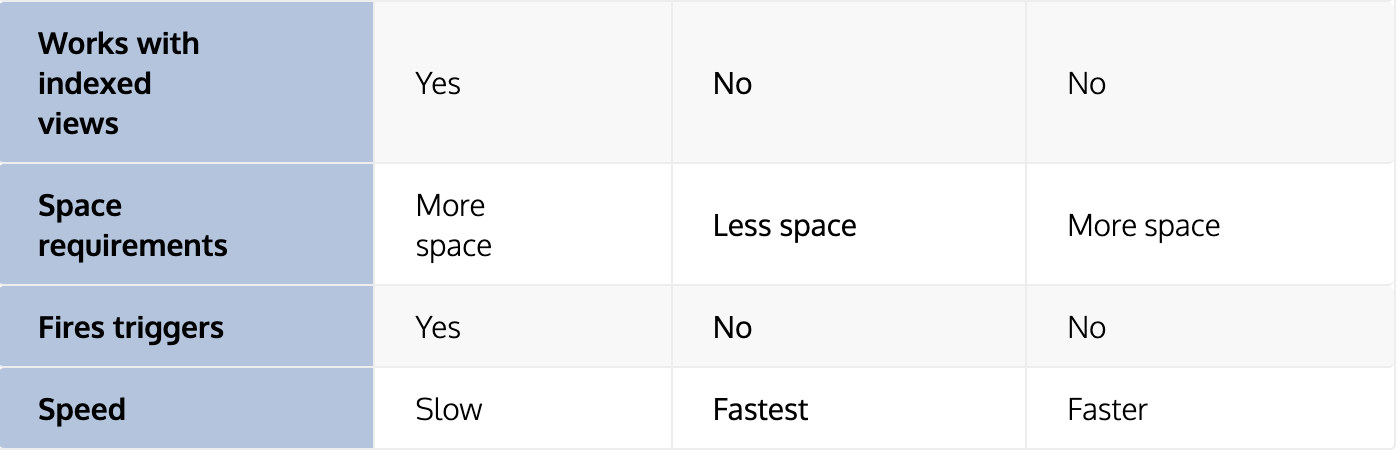 truncate很快、8级锁等特性已经是人尽皆知的事情了,相对于其他数据库,pg还可以:选择是否重置序列(
RESTART IDENTITY CONTINUE IDENTITY)、回滚、简单的授权。
truncate做了什么#
create table lzl(a int);
create index lzl_idx on lzl(a);
create sequence lzl_seq start with 1;
alter table lzl alter column a set default nextval('lzl_seq');
--select pg_relation_filepath('lzl');
--db路径
=> select oid from pg_database where datname='lzldb';
oid
--------
418679
--刚创建时候各个rel的oid=relfilenode
=> select relname,oid,relfilenode,relkind from pg_class where relname like 'lzl%';
relname | oid | relfilenode | relkind
---------+--------+-------------+---------
lzl | 428363 | 428363 | r
lzl_idx | 428366 | 428366 | i
lzl_seq | 428367 | 428367 | S
(3 rows)
=> truncate table lzl;
TRUNCATE TABLE
=> select relname,oid,relfilenode,relkind from pg_class where relname like 'lzl%';
relname | oid | relfilenode | relkind
---------+--------+-------------+---------
lzl | 428363 | 428370 | r
lzl_idx | 428366 | 428371 | i
lzl_seq | 428367 | 428367 | S
--truncate后,表和索引重建了,sequence却没有
M=> truncate table lzl RESTART IDENTITY;
TRUNCATE TABLE
=> select relname,oid,relfilenode,relkind from pg_class where relname like 'lzl%';
relname | oid | relfilenode | relkind
---------+--------+-------------+---------
lzl | 428363 | 428372 | r
lzl_idx | 428366 | 428373 | i
lzl_seq | 428367 | 428367 | S
--显示restart,sequence还是没有重建
M=> alter sequence lzl_seq restart;
ALTER SEQUENCE
M=> select relname,oid,relfilenode,relkind from pg_class where relname like 'lzl%';
relname | oid | relfilenode | relkind
---------+--------+-------------+---------
lzl | 428363 | 428372 | r
lzl_idx | 428366 | 428373 | i
lzl_seq | 428367 | 428374 | S
--显示restart sequence是会重建sequence的truncate ···RESTART IDENTITY没有重建我们sequence,alter sequence lzl_seq restart重建了sequence。应该是RESTART IDENTITY没有理解对。在看下官方文档对RESTART IDENTITY的解释
Automatically restart sequences owned by columns of the truncated table(s).
sequence必须owned by表上的列,注意不是owner to。虽然\d可以看到表上的sequence,但是它可能不属于表
 \d+ lzl;
                                              Table "public.lzl"
 Column |  Type   | Collation | Nullable |           Default            | Storage | Stats target | Description
--------+---------+-----------+----------+------------------------------+---------+--------------+-------------
a | integer | | | nextval('lzl_seq'::regclass) | plain | | 用owned by修改sequence的所属表
=> ALTER SEQUENCE lzl_seq OWNED BY lzl.a;
ALTER SEQUENCE

--查看序列的所有者信息
SELECT s.relname AS seq, n.nspname AS sch, t.relname AS tab, a.attname AS col
FROM pg_class s
JOIN pg_depend d ON d.objid=s.oid AND d.classid='pg_class'::regclass AND d.refclassid='pg_class'::regclass
JOIN pg_class t ON t.oid=d.refobjid
JOIN pg_namespace n ON n.oid=t.relnamespace
JOIN pg_attribute a ON a.attrelid=t.oid AND a.attnum=d.refobjsubid
WHERE s.relkind='S' AND d.deptype='a';
        seq        |  sch   |     tab     | col
-------------------+--------+-------------+-----
 tableserial_a_seq | public | tableserial | a
 lzl_seq           | public | lzl         | a

=> truncate table lzl RESTART IDENTITY;
TRUNCATE TABLE
M=> select relname,oid,relfilenode,relkind from pg_class where  relname like 'lzl%';
 relname |  oid   | relfilenode | relkind
---------+--------+-------------+---------
 lzl     | 428363 |      428375 | r
 lzl_idx | 428366 |      428376 | i
 lzl_seq | 428367 |      428377 | S
sequence owned by表上的列时,truncate显示带RESTART IDENTITY就会restart这个sequence,也就重建了sequence。默认以serial/bigserial方式创建的序列是被表拥有的,随表drop而删除;那些不被表拥有的序列,drop不会删除。 truncate重建特性汇总:
- 直接truncate table会重建表和索引
- truncate table+RESTART IDENTITY,会重建(也就是retart)属于这个表的sequence。只要不属于这个表的sequence,哪怕列上关联了seq的默认值,也不会重建这个seq。
源码分析#
truncate也是utility命令,很快就可以找到入口函数
src/backend/commands/tablecmds.c中的ExecuteTruncate为入口函数,注释其实已经说明truncate要获得exclusive lock,并检查权限和relation是否ok,递归检查所有需要truncate的表
void

ExecuteTruncate(TruncateStmt *stmt)

{

...

/*

* Open, exclusive-lock, and check all the explicitly-specified relations

*/

foreach(cell, stmt->relations)

{

...
LOCKMODE lockmode = AccessExclusiveLock;  //8级锁
...

rel = table_open(myrelid, NoLock); //打开表


void
ExecuteTruncate(TruncateStmt *stmt)
{
...
	foreach(cell, stmt->relations)
	{
...
		LOCKMODE	lockmode = AccessExclusiveLock; //8级锁
...
		/* open the relation, we already hold a lock on it */
		rel = table_open(myrelid, NoLock); //打开表
...
		truncate_check_activity(rel);  //虽然已经有锁了,但是还是要验证是否在使用
...
		if (recurse) //递归执行
		{
...
			children = find_all_inheritors(myrelid, lockmode, NULL); //找到所有继承子表

			foreach(child, children)
			{
...
				 //上面只检查了父表,递归要检查子表
				truncate_check_rel(RelationGetRelid(rel), rel->rd_rel);
				truncate_check_activity(rel);

				rels = lappend(rels, rel);  //加入到待truncate的rel队列中
				relids = lappend_oid(relids, childrelid);
...
			}
		}
		//递归结束
		//发现truncate only分区父表,直接报错
		else if (rel->rd_rel->relkind == RELKIND_PARTITIONED_TABLE)
			ereport(ERROR,
					(errcode(ERRCODE_WRONG_OBJECT_TYPE),
					 errmsg("cannot truncate only a partitioned table"),
					 errhint("Do not specify the ONLY keyword, or use TRUNCATE ONLY on the partitions directly.")));
	}

	//主体函数
	ExecuteTruncateGuts(rels, relids, relids_logged,
						stmt->behavior, stmt->restart_seqs);

	/* And close the rels */
	foreach(cell, rels)
	{
		Relation	rel = (Relation) lfirst(cell);

		table_close(rel, NoLock);
	}
}ExecuteTruncateGuts函数不仅被truncate命令调用,还被订阅端调用(发布订阅可以同步truncate)。
void
ExecuteTruncateGuts(List *explicit_rels,
					List *relids,
					List *relids_logged,
					DropBehavior behavior, bool restart_seqs)
{
...
	rels = list_copy(explicit_rels);
	if (behavior == DROP_CASCADE)  //如果指定了cascade选项,提取所有reference的relation
	{
		for (;;)
		{
...
			newrelids = heap_truncate_find_FKs(relids); //找到fk
			if (newrelids == NIL)
				break;			/* nothing else to add */ //没有rel直接退出

			foreach(cell, newrelids)
			{
...
				rel = table_open(relid, AccessExclusiveLock); //所有rel获得AccessExclusiveLock
				ereport(NOTICE,
						(errmsg("truncate cascades to table \"%s\"",
								RelationGetRelationName(rel))));
				truncate_check_rel(relid, rel->rd_rel);  //检查是否是可以truncate的对象,得是存储数据的表
				truncate_check_perms(relid, rel->rd_rel);  //检查是否有权限
				truncate_check_activity(rel);  //检查是否在使用
...
			}
		}
	}

...
	if (restart_seqs) //restart seq的处理
	{
		foreach(cell, rels)
		{
			Relation	rel = (Relation) lfirst(cell);
			List	   *seqlist = getOwnedSequences(RelationGetRelid(rel));
...
			//只是做sequence的权限检查
				if (!pg_class_ownercheck(seq_relid, GetUserId()))
					aclcheck_error(ACLCHECK_NOT_OWNER, OBJECT_SEQUENCE,
								   RelationGetRelationName(seq_rel));
...
		}
	}

...

	//执行所有before truncate触发器
	foreach(cell, rels)
	{
		ExecBSTruncateTriggers(estate, resultRelInfo);
		resultRelInfo++;
	}

//正式开始truncate
	foreach(cell, rels)
	{
...
		//如果是分区父表,啥都不做
		if (rel->rd_rel->relkind == RELKIND_PARTITIONED_TABLE)
			continue;

		//如果是foreign table的处理
		if (rel->rd_rel->relkind == RELKIND_FOREIGN_TABLE)
		{
		...
		}

...
		 //如果是同一事务,因为可能会回退,直接执行heap_truncate_one_rel函数,不创建新的relfilenode
		if (rel->rd_createSubid == mySubid ||
			rel->rd_newRelfilenodeSubid == mySubid)
		{
			/* Immediate, non-rollbackable truncation is OK */
			heap_truncate_one_rel(rel);
		}
		else
		{
...
			//设置NewRelfilenode
			RelationSetNewRelfilenode(rel, rel->rd_rel->relpersistence);

			heap_relid = RelationGetRelid(rel);

			 //toast同理
			toast_relid = rel->rd_rel->reltoastrelid;
			if (OidIsValid(toast_relid))
			{
				Relation	toastrel = relation_open(toast_relid,
													 AccessExclusiveLock);

				RelationSetNewRelfilenode(toastrel,
										  toastrel->rd_rel->relpersistence);
				table_close(toastrel, NoLock);
			}

...
			 //重建索引
			reindex_relation(heap_relid, REINDEX_REL_PROCESS_TOAST,
							 &reindex_params);
		}

		pgstat_count_truncate(rel); //更新pgstat的truncate计算
	}

...
	//重置sequence
	foreach(cell, seq_relids)
	{
		Oid			seq_relid = lfirst_oid(cell);

		ResetSequence(seq_relid);
	}

	//写wal
	if (list_length(relids_logged) > 0)
	{
	...
	}


	//触发AFTER TRUNCATE triggers
	resultRelInfo = resultRelInfos;
	foreach(cell, rels)
	{
		ExecASTruncateTriggers(estate, resultRelInfo);
		resultRelInfo++;
	}
...
}
ExecuteTruncateGuts函数根据truncate选项进行处理,处理过程如下:
- 根据cascade选项找到所有reference的外键表
- 触发before truncate触发器
- 执行truncate
- 如果是同一事务,不立即生成
NewRelfilenode,直接调用函数heap_truncate_one_rel进行truncate - 如果不是同一事务,调用
RelationSetNewRelfilenode新建NewRelfilenode
reindex_relation函数重建索引- 根据restart identity重置sequence
- 写wal日志
- 触发after truncate触发器
后面大概追了下函数,套娃比较多
RelationSetNewRelfilenode
table_relation_set_new_filenode
relation_set_new_filenode在这里插入代码片
heapam_relation_set_new_filenode
RelationCreateStorage
然后到src/backend/storage/smgr/smgr.c中的smgrcreate和smgr_create。后面就没看太懂了(一到函数指针就有点追不到的感觉,先这样吧~)···
对于smgr.c有这样的注释:
public interface routines to storage manager switch All file system operations in POSTGRES dispatch through these routines.
任何文件系统操作都会经过smgr(storage manager);到这里就是文件系统操作了。
reference#
https://www.postgresql.org/docs/15/sql-truncate.html https://www.postgresql.org/docs/current/mvcc-caveats.html https://pgpedia.info/t/truncate.html https://www.orafaq.com/wiki/SQL_FAQ https://learnsql.com/blog/difference-between-truncate-delete-and-drop-table-in-sql/